BlogComparisons
Why a POS on its own still leaves you reconciling
A POS tells you what was sold. It cannot tell you what you had, what you paid for it, or whether the money landed. That work still falls to you.
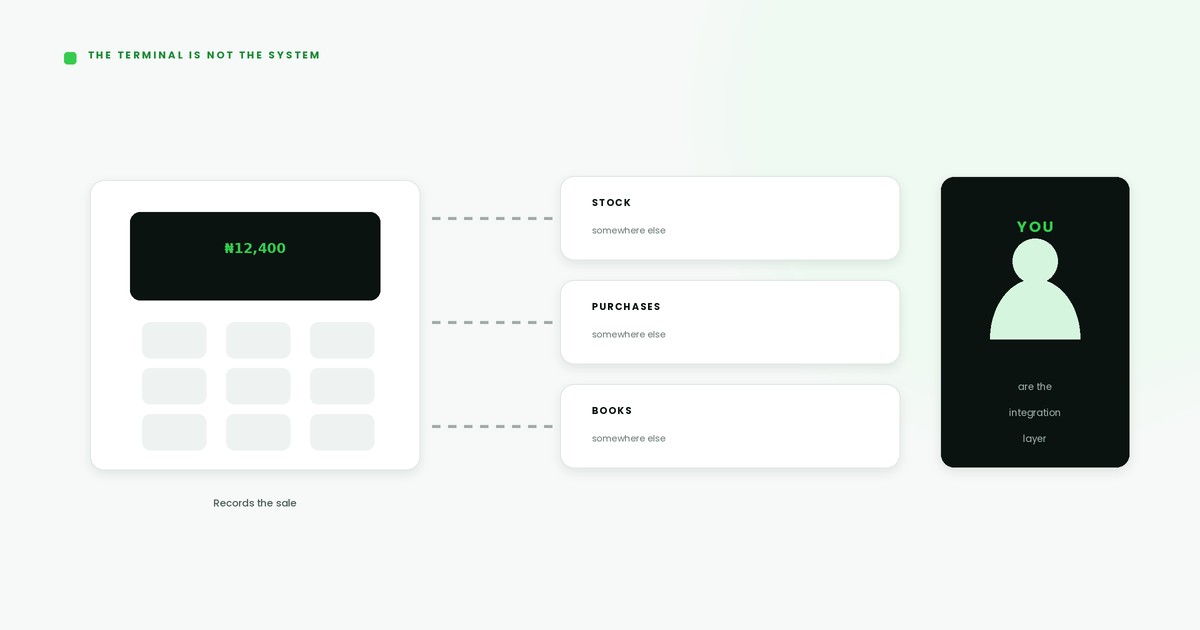
In Nigeria the word POS means two different things, and the confusion costs people money.
There is the terminal, the little machine that takes a card or prints a transfer receipt, and there is POS software, the till system that records what was sold and at what price. Most shops have one or both, and most shop owners still spend Saturday evening with a calculator.
That is the tell. If a POS solved the problem, nobody would be reconciling.
What a POS actually does, and it is not nothing
A POS records the sale. Item, quantity, price, time, payment method, and who was at the counter. That is genuinely valuable, and a shop that has it is ahead of a shop that does not.
A payment terminal is even less optional. You cannot take a card without one, transfer-only trading loses you customers, and the settlement report from your bank or provider is the only independent record of money received that you will ever have.
None of this is the thing to replace. Wayg does not replace a payment terminal, does not process payments and is not a payment gateway. Keep your terminal. The question is what happens to the sale after the terminal beeps.
You are the integration layer
Here is the shape of the problem. The sale lands in the POS. The stock sits on a shelf or in a spreadsheet. The purchase sits in a supplier invoice in a drawer or a WhatsApp thread. The money lands in a bank account and a cash box. The books, if they exist, live with an accountant who sees them once a quarter.
Five records, no joins. The joining is done by a person, by hand, usually on an evening, usually tired. That person is you.
A POS is a very good record of one event. Reconciliation is the job of making five records of the same event agree.
The three reconciliations you are doing by hand
Every shop with a POS and nothing joined to it does these three.
One: money against sales. Take the POS total for the day. Subtract card and transfer sales. What is left should be the cash in the box. Then take the terminal settlement, which lands a day or two later and net of charges, and match it back to the card sales it came from. Every discrepancy has to be chased: a transfer that came in without a receipt, a refund given in cash, money taken out of the box for fuel, a customer who part-paid.
Typical hand time: 20 to 40 minutes a day, or a painful two hours once a week if you batch it. Treat those as illustrative figures, not a benchmark.
Two: stock against sales. The POS says you sold 14 cartons. The shelf says something else. To find out which, you count, and then you have to account for everything that moved stock without being a sale: goods received, breakage, samples, staff purchases, a return, a transfer to your second shop. A POS that does not hold stock levels cannot even show you the expected figure, so the count has nothing to be compared against.
Typical hand time: an hour a week on a partial count, a half day on a full one. How to run a stock count that balances has the method that makes this shorter.
Three: sales and purchases against the books. Your accountant needs revenue, cost of goods sold and expenses. The POS gives revenue. Cost of goods sold requires matching what you sold to what you paid for it, which requires purchase records, which are in the drawer. So either you sit down and type up invoices, or your books are an estimate.
Typical hand time: two to four hours a month, and it is the one most often skipped. When it is skipped, you find out at year end. How to close your books every month in under an hour exists because this is the reconciliation that quietly decides whether you know your margin.
Add them up, conservatively, and you are looking at something in the range of eight to fifteen hours a month of arithmetic. Illustrative again, but if that feels low, that is the point.
What the gaps cost besides time
Time is the visible cost. The invisible one is that the differences never get explained.
There is no published Nigerian survey of shrinkage, so treat this as the shape of the problem rather than your number: the US National Retail Federation's National Retail Security Survey 2023 put retail shrink at 1.6% of retail sales in FY2022, up from 1.4% the year before, and found internal and external theft together made up close to two thirds of it. The rest is process: receiving errors, miscounts, unrecorded adjustments, duplicate or missing transactions.
Process errors are exactly the category that a hand reconciliation hides, because when the numbers do not agree and it is late, the temptation is to write the difference off as "sha, it will balance next week". Shrinkage: what it costs and the six places it hides goes through where it accumulates.
POS alone versus one set of records
| POS software alone | Payment terminal | Wayg | |
|---|---|---|---|
| Records the sale | Yes | Records the payment only | Yes |
| Takes card and transfer payments | No | Yes | No, Wayg is not a payment gateway |
| Holds stock levels | Sometimes, varies by product | No | Yes |
| Records purchases and supplier costs | Rarely | No | Yes |
| Produces cost of goods sold | No | No | Yes |
| Flags a variance between cash, stock and books | No | No | Daily reconciliation with variance detection |
| Roles and audit trail across the whole business | Till-level only | No | Yes, across products |
| Cost | Published pricing not confirmed at the time of writing across the Nigerian POS market | Provider dependent | Free plan at ₦0; paid plans ₦5,000 to ₦50,000/month |
A note on that pricing row, because it matters more than the row itself: we could not verify published prices across the Nigerian POS software market at the time of writing, so this comparison stays on capability. Anyone quoting you a competitor's price in a blog post, including us, should be able to show you where it came from.
What changes when the records are joined
Concretely, three things stop being your job.
Recording the sale moves the stock. There is no second step, so the expected stock figure is always there to count against. That turns the weekly stock reconciliation from "count and then reconstruct what should have happened" into "count and read the difference".
The purchase and the sale meet, so cost of goods sold is a by-product of trading rather than a monthly project. Margin becomes something you can look at on a Wednesday.
And the variance gets raised by the system rather than noticed by you. Wayg runs daily reconciliation with variance detection across cash, stock, transfers and books. The number of variance checks depends on the plan: three on Starter, six on Basic, eleven on Growth, fifteen on Scale.
You still investigate. Nothing removes the walk to the shelf. But you investigate a flagged difference on one product on the day it happened, instead of discovering a hole at month end with no idea which week it came from. As an illustrative example: a ₦4,300 gap on one line on Tuesday is a question somebody can still answer, while the same ₦4,300 buried inside a ₦70,000 month end difference is just a write-off.
Frequently asked questions
Do I still need a payment terminal if I use Wayg?
Yes. Wayg is not a payment gateway and does not process card or transfer payments. Keep your terminal and your bank relationship; Wayg is where the sale, the stock movement and the resulting books live.
Is POS vs inventory system really a choice?
Not usually. The realistic choice is between a POS that stands alone and a POS that sits on the same records as your stock, purchases and books. The second one removes reconciliations rather than producing them.
My POS already shows stock. Is that enough?
It is a good start, and for a single shop with few suppliers it may be all you need. The gap usually shows up at the purchase side: if goods received and supplier costs are not in the same system, you have stock quantities without stock value, and no cost of goods sold.
How long should reconciling actually take?
When sales, stock and purchases share one record, a daily check is minutes and a monthly close is closer to an hour than an afternoon. The long version of that is in how to close your books every month in under an hour.
Put the sale, the stock and the cost in one place
Keep the terminal, and the till habits your staff already have. The change worth making is what happens after the beep: whether the sale moves your stock, meets its cost and lands in your books without you carrying it there.
Get started freeThe free plan needs no card.
Sources: VNDLY: Inventory shrinkage statistics, compiling the NRF National Retail Security Survey 2023