BlogBooks
How to close your books every month in under an hour
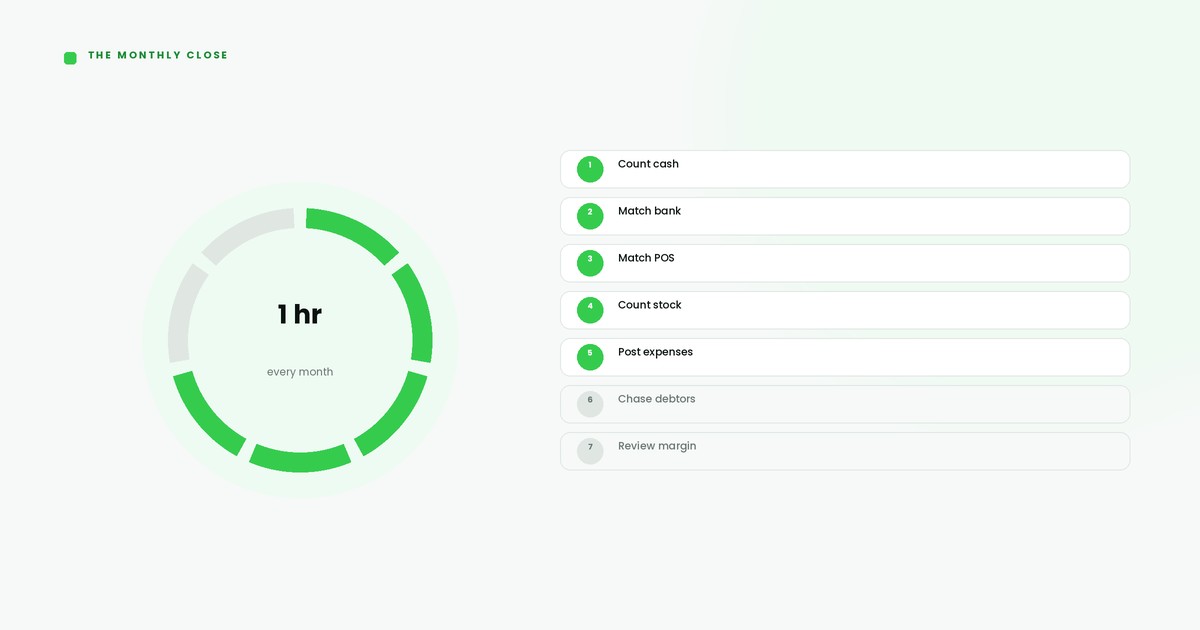
Seven steps, fifty-five minutes, in a fixed order. The order is the whole trick: each step feeds the next.
Most small businesses do not close their books monthly. They close them annually, in a panic, in June, from a carton of receipts.
The reason is not laziness. It is that nobody ever showed them a close that fits in an evening.
Here is one. Seven steps, fifty-five minutes, same order every month. The order is not arbitrary: each step produces something the next step needs, and doing them out of order is what turns an hour into a weekend.
The seven steps and what each one costs you
| # | Step | Minutes | What you need in front of you | Done looks like |
|---|---|---|---|---|
| 1 | Count cash | 5 | Drawer, safe, float record | Counted figure written down, before you look at anything else |
| 2 | Match the bank | 10 | Bank statement for the month | Every line ticked or queried |
| 3 | Match the POS terminal | 8 | Terminal settlement report | Settlements traced into the bank |
| 4 | Spot-count fast-moving stock | 12 | Top 20 lines by value | Counted versus expected, variances noted |
| 5 | Post expenses | 10 | Receipts, transfer alerts, diesel log | Nothing left unposted |
| 6 | Chase debtors | 8 | Credit sales ledger | Every debt aged and one contact made |
| 7 | Review margin | 6 | Sales, opening and closing stock, purchases | A gross margin percentage you believe |
Fifty-five minutes. Not because each step is trivial, but because each one is small when the previous one has already been done.
Why the order is the order
Cash first, because cash decays fastest. Count before you open a statement, before you look at a report, before anyone tells you what the number should be. A count taken after you have seen the expected figure is not a count, it is a confirmation. Count the drawer, count the safe, deduct the float, write it down.
Bank second, because the bank is the one record you did not write. Everything else in your business is your own account of events. The statement is somebody else's. Tick every line: takings banked, transfers in, supplier payments out, charges. What is left unticked is your list of questions.
POS third, because settlement lags. A terminal shows you what was swiped. The bank shows you what actually arrived, often a day or two later and sometimes net of charges. You cannot match a terminal properly until the bank is ticked, which is why step 3 cannot come before step 2.
Stock fourth, because now you know what sales were real. Steps 1 to 3 gave you money received. Step 4 asks the other question: did the goods leave in the quantities the system says? Do not count everything. Count the top 20 lines by value, which in most shops is well over half the money on the shelves. Our full stock count method covers the annual full count.
Expenses fifth, because margin needs them and they are the easiest to forget. Diesel, transport, repairs, airtime, the boy you paid ₦3,000 to offload. If it is not posted this month it will never be posted.
Debtors sixth, because the month is still fresh. A customer will argue with an invoice from March. They rarely argue with one from last week.
Margin last, because it depends on all six. You cannot compute a gross margin you trust until sales are verified, stock is counted and expenses are in.
Close the books while you can still remember the week. Every day you wait, the answers get more expensive to find.
A named scenario: the ₦18,000 question
Illustrative example, not a benchmark. A provisions shop's month:
- Sales recorded in the system: ₦4,120,000
- Cash counted and banked across the month: ₦960,000
- Transfers received: ₦1,900,000
- POS settlements landed in the bank: ₦1,200,000
- Credit sales sitting in the debtor ledger: ₦42,000
Accounted for: ₦960,000 + ₦1,900,000 + ₦1,200,000 + ₦42,000 = ₦4,102,000.
Gap: ₦18,000.
That is 0.4% of sales, which sounds like nothing and is not nothing. At ₦18,000 a month it is ₦216,000 a year, walking out of a business whose whole net profit might be a few times that.
The point of the close is not that you find the ₦18,000 every time. It is that you find out it exists in October rather than next June, while the answer is still recoverable: an unrecorded discount, a terminal charge nobody posted, a refund given in cash, a sale rung up wrong. Where stock and cash gaps hide covers the usual suspects.
Step 7 in detail, because margin is the one people fake
Gross margin is where owners quietly guess, and a guessed margin is how a business sells hard all year and banks nothing.
Cost of goods sold = opening stock + purchases − closing stock.
Gross margin % = (Sales − Cost of goods sold) ÷ Sales × 100.
Same illustrative shop:
| Line | Amount |
|---|---|
| Opening stock | ₦2,600,000 |
| Purchases in the month | ₦3,150,000 |
| Closing stock (from step 4 plus the system) | ₦2,380,000 |
| Cost of goods sold | ₦3,370,000 |
| Sales | ₦4,120,000 |
| Gross profit | ₦750,000 |
| Gross margin | 18.2% |
Now the question that makes the whole hour worth it: does 18.2% cover rent, salaries, diesel and everything else? If monthly fixed costs are ₦700,000, gross profit of ₦750,000 leaves ₦50,000. That business is working extremely hard to stand still, and it will not find that out from a bank balance. Pricing so that you actually make money is the next thing to read if that number looks familiar.
Where the close sits in the month
Every obligation a business has, to a landlord, a supplier, a lender, a partner or an authority, eventually asks the same thing: what did you sell, what did you spend, and what is left. Close on the last day of the month and you already have the answer before anyone asks for it.
People miss deadlines far less often because they forgot the date, and far more often because when the date arrived they still did not know what their own numbers were. The close is what removes that excuse. Whoever you owe a figure to, and whatever they need it for, you produce it in minutes instead of spending a weekend reconstructing it.
Frequently asked questions
How long should a monthly close take for a small shop?
Under an hour is realistic if daily sales, cash and stock are already being recorded as they happen. If the close is where you first enter a month of transactions, it is data entry, not a close, and it will take a day.
Do I need to count all my stock every month?
No. Spot-count the top 20 lines by value monthly and run a full count less often. The monthly spot-count catches drift early, which is when it is still cheap to explain.
What is a normal gross margin for a Nigerian retail shop?
There is no reliable published figure we can point you to, and margins vary enormously by trade, so treat anyone quoting one number for all retail with suspicion. Measure your own monthly and watch the trend rather than the absolute.
Should I close the books myself or wait for an accountant?
Close them yourself, monthly, and give your accountant a closed month instead of a carton. The accountant's value is in advice and filings, not in sorting your diesel receipts at ₦X per hour.
Make the close a report, not an evening
Wayg keeps point of sale, inventory, store management and bookkeeping on one set of records, and runs daily reconciliation with variance detection across cash, stock, transfers and books. The ₦18,000 question gets asked on the day it happens rather than at the end of the month.
Get started freeThe free plan needs no card.
Every naira figure in this article is an illustrative example rather than a benchmark. The routine is the point, not the numbers in it.