BlogComparisons
Wayg vs the notebook and calculator
The notebook needs no battery, no network and no password. Here is what it still cannot do, and the honest case for running it alongside software.
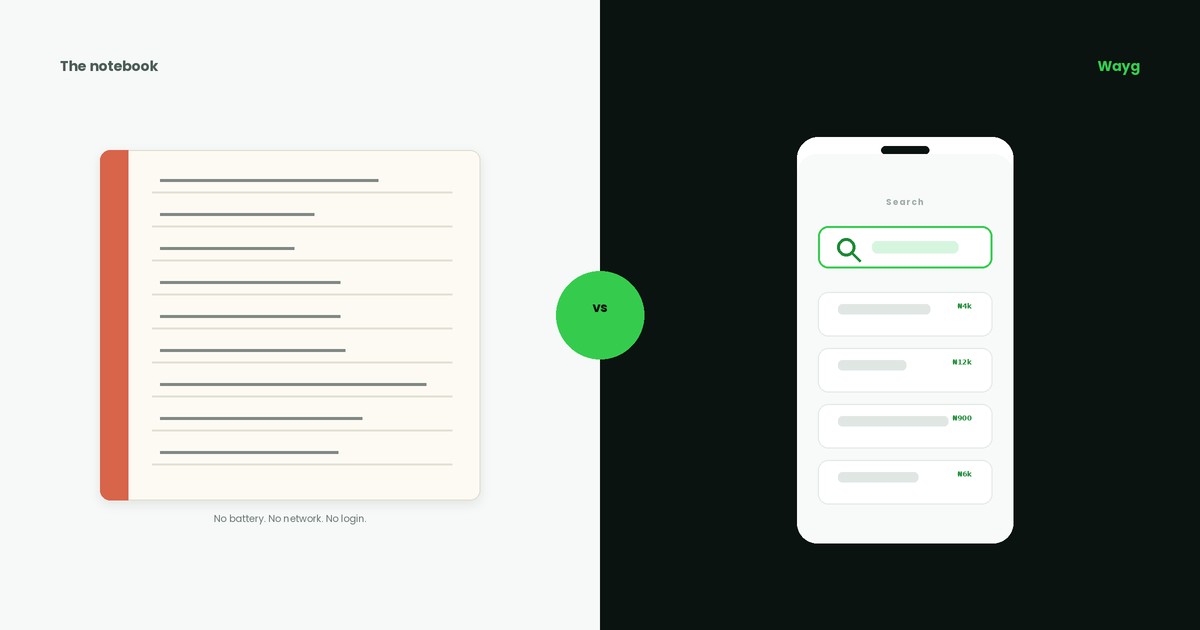
There is a shop on Ogunlana Drive where the owner can tell you, from memory and a ruled notebook, what she sold on a Tuesday in March. Two columns, a date at the top of each page, and a total ringed at the bottom in biro.
That is a system. It is not a placeholder for a system. Anybody who tells her she is "not keeping records" has not looked at the book.
But she closes at eight and spends forty minutes with a calculator, and she cannot tell you which of her forty lines has not moved since Easter.
Everything the notebook gets right
NEPA can take light and the notebook still works. There is no charging, no data, no app update that moves the button you use every day.
It never locks you out. No password, no OTP, no "session expired" while a customer waits with cash in his hand.
It is fast for the person who owns it. A practised hand writing "6 Peak sachet 2,400" takes about two seconds, which is faster than most software, and it does not interrupt the conversation with the customer.
It costs the price of a book and a biro, and it belongs to you completely. No vendor can raise your price, change your terms or go out of business.
And it is legible evidence of intent. A consistently kept book, dated, with totals, is a far better starting position than a phone full of transfer alerts and a memory.
The five things it cannot do
None of these are about neatness. They are structural.
It cannot be in two places. The book is where the book is. If you are at Balogun buying stock and your boy at the counter needs to know whether you still have the small size, the answer is a phone call and a guess. Open a second branch and you now have two books that will never agree, because nothing joins them.
It cannot total itself. Every figure you want costs you arithmetic. Daily takings, monthly takings, what one customer owes, what one product earned: each is a pass through the pages with a calculator. So most owners compute the one number they need, daily takings, and skip the rest. The skipped ones are where margin hides. Pricing so that you actually make money is mostly a set of numbers a notebook will not volunteer.
It cannot tell you what did not sell. This is the quiet one. A sales book records events. Dead stock is a non-event, so it never appears. Four cartons that have not moved in five months are invisible in a book that only writes down movement, while they sit there holding your money. Software can answer "show me everything with no sale in 60 days" in a second, and a notebook structurally cannot.
It cannot prove anything to anybody. Sooner or later somebody who is not you needs to believe your numbers. A bank before a loan. A landlord before a bigger shop. A partner before a deal. An adviser before almost anything. A good notebook can support a claim about what your business turned over. A notebook with three missing pages and a water stain cannot, and neither can one that records takings but never records what was bought.
It cannot be searched. "When did I last buy from that supplier, and at what price?" is a twenty minute job in a book and a two second job anywhere else. Multiply that by the number of times a week you want an answer and decide not to bother.
A notebook is a perfect record of what happened and a poor tool for noticing what did not.
Where each one actually wins
| Notebook and calculator | Wayg | |
|---|---|---|
| Cost | The price of a book and a biro | Free plan at ₦0; paid plans from ₦5,000/month |
| Works with no light, no network | Yes | No, it needs a connection |
| Speed of a single entry | Very fast for the owner | Fast, and voice or text through the Wayg Assistant |
| Two people, two places | Not possible | Multiple users by plan, with roles |
| Totals a day, a month, a customer | By hand, every time | Automatic |
| Shows what has not sold | No | Yes |
| Searchable history | No | Yes |
| Audit trail of who changed what | No | Yes |
| Variance between cash, stock and books | You notice it, or you do not | Daily reconciliation with variance detection |
| Survives fire, water, theft | No | Records are held online |
| Payroll, lending, filing returns to the revenue service | No | No, and Wayg does not claim to |
That last row matters in this comparison specifically, because people expect software to be magic. Wayg is not a bank, does not run payroll and does not submit anything to the tax authority on your behalf. What it does is keep the records that your accountant or adviser needs in order to do those things properly.
The hybrid, described honestly
Most people who move do not stop writing. Here is what the hybrid actually looks like, including the part where it goes wrong.
The notebook stays at the counter for the rush. Between four and eight on a Friday, when three customers are waiting, you write. Nobody should be tapping a screen at that moment.
Then, once, at close, the day goes in. Not entry by entry from memory a week later: the same evening, off the page. With Wayg that step can be spoken rather than typed, because the Assistant takes voice or text in plain language, which is closer to the speed of reading your own handwriting aloud.
The failure mode is the backlog, and you should plan for it. Two days missed becomes a week, a week becomes "I will do it on Sunday", and Sunday becomes never. The fix is not discipline, it is scope. Enter takings and stock movements daily. Leave supplier invoices and expenses for one sitting a week. A hybrid that runs forever beats a full system you abandon in March.
If you are moving an existing book over, Wayg imports from handwritten notes as well as spreadsheets, so your opening stock and product list do not have to be typed twice. Do one proper count on the day you start, using the method in how to run a stock count that balances, and let that count be your opening position.
When you should just keep the notebook
If you are one person, you sell fewer than about thirty lines, you close the shop yourself and nobody else ever touches your stock or your cash, the notebook is not holding you back. It is proportionate, and the honest advice is to keep it and spend the money on stock instead.
The point where it stops being enough is usually staff. The day someone else sells while you are not there, your book stops being a record and becomes a report of what that person chose to tell you. That is not a character judgement. It is arithmetic: an unwitnessed count plus a handwritten total has no independent check against it.
Frequently asked questions
Is manual bookkeeping still legal for a small business in Nigeria?
The law requires you to keep records that substantiate your figures, not that you keep them in software. A complete, consistent, dated manual record can satisfy that. The risk with a notebook is not legality, it is completeness and survival. This is not tax advice.
Do I have to stop writing in my notebook?
No. The common pattern is writing at the counter during the rush and entering the day once at close. Wayg imports from handwritten notes, so the notebook can stay part of the process rather than being replaced on day one.
What if light goes and I cannot use the app?
Write it down. Then enter it when the connection is back. A notebook that acts as your fallback is a feature of the hybrid, not a failure of it, and this is a genuine advantage manual records hold over any online system.
How long does it take to enter a day's sales?
For a small shop, it is usually a few minutes if you do it the same evening from the page. It becomes an hour if you leave it a fortnight, which is the real reason most manual-to-software moves stall.
Enter one week and compare the totals
The test that settles this costs you a week. Keep writing exactly as you do now, and enter the same days into Wayg at close. On Saturday compare your calculator total to the app total, and see which one finds the difference first. The free plan covers one user and 50 products, enough for a real shop to run that test.
Get started freeThe free plan needs no card.
This post is not tax advice. Tax figures, thresholds and dates change, so confirm anything here with a tax adviser or the revenue service before you act on it.