BlogStock
How to run a stock count that balances
Full count or cycle count, why you freeze movement, why the counter must not see the expected number, and what to do with a variance.
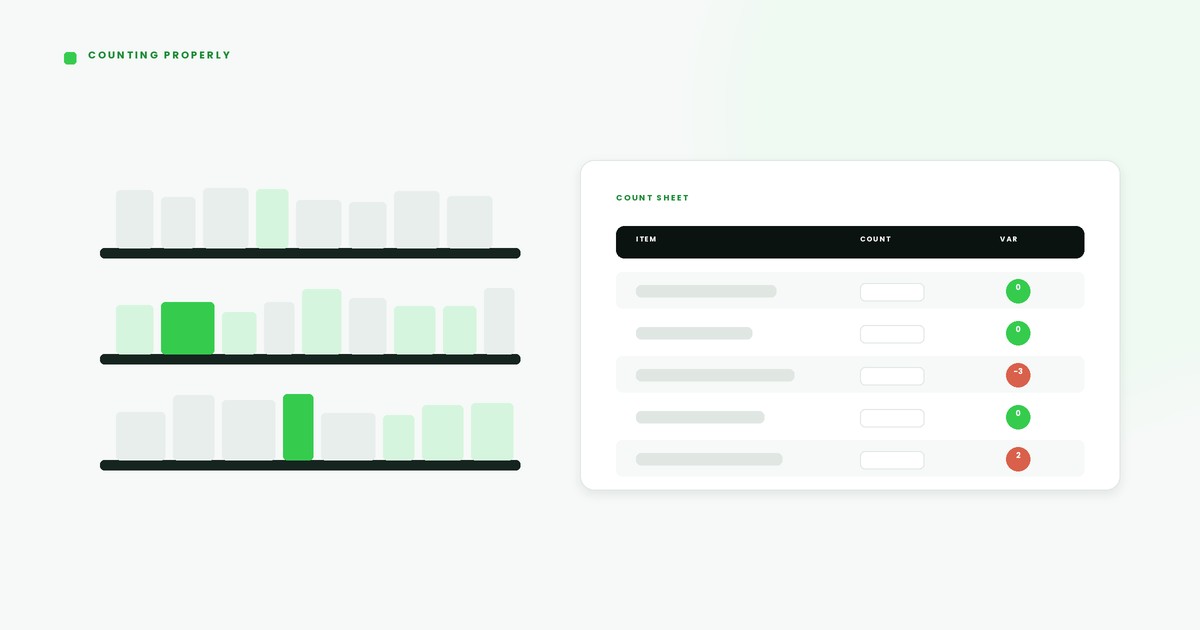
Most stock counts fail before anyone picks up a pen. The shop is still selling. One person is counting. The count sheet already has the expected quantity printed next to every line, so the counter writes what the sheet says and goes home.
That count did not measure anything. It copied your records back to you and gave them a signature.
A count that balances is a count you designed so that it cannot be quietly fudged.
Full count or cycle count
A full count stops the whole business and counts everything in one go. A cycle count counts a slice of your items every week so that everything gets counted on a rotation, and the shop never closes.
Most Nigerian shops need both. Do a full count once or twice a year, usually at your financial year end, because that is the number your books lean on. Do cycle counts every week, because that is what actually keeps the records true.
Weekly cycle count target = total items ÷ weeks between full coverage
If you hold 600 items and want every one counted twice a year, that is 600 ÷ 26, so 23 lines a week at minimum. Add your fast movers on top and you land near 50 lines, about 40 minutes for two people, and your top sellers get counted twelve times or more.
Freeze the movement or the count is fiction
You cannot count a moving number. If a customer buys three cartons while your storekeeper is counting aisle two, the sheet and the system will disagree for a reason that has nothing to do with accuracy.
Freezing does not have to mean closing. Choose one:
- Count after the shutters come down, with no receiving and no sales until the count is entered.
- Count before opening, with yesterday's sales fully posted.
- Count one section at a time and block movement in that section only.
Whatever you pick, write the cut-off time on the sheet. Any delivery arriving during the count goes in a marked corner, untouched and uncounted, and is received afterwards. A carton counted and then received again is a phantom carton.
A count that shows the counter the expected figure is not a count. It is a signature.
Count blind, always
A blind count means the count sheet shows the item, the location and an empty box. No expected quantity. No last count. Nothing to anchor to.
This single rule changes more than any software. Show someone the number 52 and human nature will find 52. Show them an empty box and they will count.
The expected quantity only appears afterwards, when you compare. If the variance is large, you recount that line, still blind, before anyone starts explaining. A good share of large variances turn out to be counting errors, and a second blind count is cheaper than an argument.
Two people, one sheet
One counts, one records. They swap roles halfway through so neither person is tired in the same job for the whole count.
The second person is not there for suspicion. They are there because counting and writing at the same time is how you get 12 written where 21 was counted. Where you can, keep the person who controls receiving for a category off that category. With three staff that is not always possible, so rotate who counts which aisle month to month instead.
Sign the sheet. Both names, date, cut-off time. A count with no name on it cannot be questioned later, which sounds convenient until you need to ask a question.
The count sheet
Keep it to seven columns and print it in item order matching the physical shelf layout, not alphabetical order. Counters walk shelves, not alphabets.
| Column | What goes in it |
|---|---|
| Location | Aisle, shelf or store, for example "Store 2, rack C" |
| Item code | The barcode or your own code, never the name alone |
| Item name and size | "Peak Milk 400g tin", enough to prevent a mix-up |
| Unit | Carton, tin, sachet, kg. Decide before you start |
| Count 1 | Written by the recorder as the counter calls it |
| Count 2 | Only filled in on a recount |
| Notes | Damaged, expired, wrong shelf, unlabelled |
Two rules about units save most of the pain. Count in the unit you sell in, and agree what a carton contains before the first line. A shop that buys in cartons of 24 and sells in singles must decide which one the sheet is in, and then never mix.
What to count, how often
Rank your items by sales value over the last 90 days, then split the list. This is your own data, so the thresholds are yours to set, but the shape below works for most shops.
| Class | How to identify it | Count frequency | Why |
|---|---|---|---|
| A | Top 20% of items by sales value | Weekly | Most of your money moves here, so errors compound fast |
| B | Next 30% by sales value | Monthly | Steady sellers, moderate exposure |
| C | Bottom 50% by sales value | Quarterly | Low value, low movement, cheap to be wrong about briefly |
| High risk | Small, valuable, easy to pocket: phone accessories, razor blades, recharge cards | Weekly, whatever the class | Value per cubic centimetre is the real risk factor |
| Perishable | Fresh, chilled, short expiry | Every one or two days | You are counting expiry dates as much as units |
| Everything | The full shop | Once or twice a year | The number your books stand on |
When a variance will not explain itself
You recounted blind, you checked transfers, receiving, returns and the damage log, and five cartons are still missing. Do not leave it open. An unresolved variance sitting in the system for weeks makes every later count unreliable, because you no longer know which discrepancy is new.
Adjust the stock to the counted figure, because the shelf is the truth. Then record the adjustment with three things: the reason code "unexplained", the value in naira, and the name of the person who approved it. Approval sits above the person who counted.
Track two numbers over time. Count accuracy is the share of counted lines with zero variance, and it should climb. Unexplained variance value is the naira total of adjustments with no cause, and it should fall. If it is rising in one category or one shift, you have narrowed the search without accusing anybody. The six causes of a stock discrepancy are where you go next, and if the pattern repeats, read the shrinkage piece.
Frequently asked questions
How often should a small shop do a full stock count?
Once a year as a minimum, tied to your financial year end, and twice if you hold perishables or high-value items. Weekly cycle counts do the real work in between, so the full count stops being a crisis.
Do I have to close the shop to count stock?
No, but you must freeze movement in whatever you are counting. Counting after close or before opening is the simplest freeze, and section-by-section freezing works for a storeroom.
What is a blind count?
A count where the person counting cannot see the expected quantity. It is the single most effective control in the whole process, because it removes the temptation to make the shelf agree with the sheet.
Who should approve a stock adjustment?
Somebody other than the person who counted, ideally the owner or a manager. Adjustments move value out of your stock and into your costs, so they need the same discipline as spending cash.
Make the count a Tuesday habit instead of a year-end event
Wayg builds the count sheet from your own sales data, hides the expected figure from the counter, and posts the variance against sales, transfers and receiving on the same set of records. You see which cause fits before the shop reopens.
Get started freeThe free plan needs no card.