BlogPlaybooks
Running a provisions shop: the daily numbers that matter
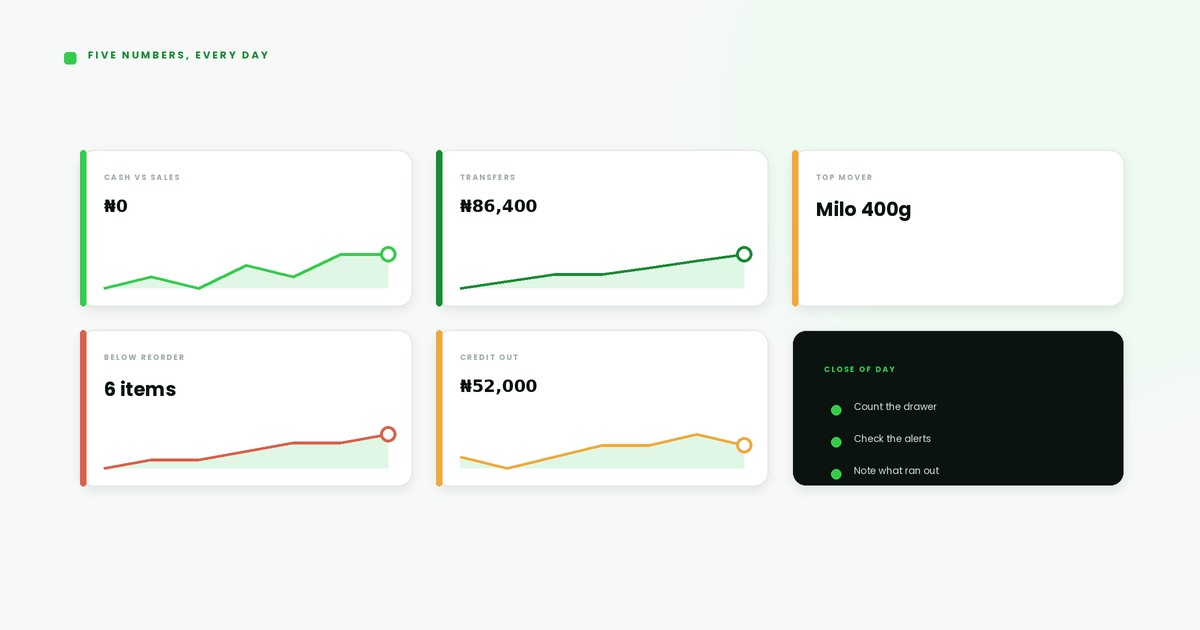
Five numbers, checked before you lock up, tell you more about your shop than any monthly summary ever will.
It is 8:40pm in Surulere. The shutter is half down, the last customer wanted one sachet of tomato paste, and your boy at the counter is counting the tin.
Most shop owners do one thing at this point: count the cash, take out what they need, and go home. That is not a close. That is emptying a tin.
A real close takes about ten minutes and produces five numbers. Check them every day for a week and you will know things about your shop that a monthly total will never tell you.
Number one: cash in the drawer against recorded cash sales
This is the only number most people already track, and they usually track it wrong, because they compare today's cash against a feeling.
The comparison you want is arithmetic. Opening float plus recorded cash sales, minus cash paid out for anything (the okada that delivered the crate, the small transport you gave the boy, diesel for the generator), should equal the cash in the tin.
A shop does not lose money in one big theft. It loses it in ₦700 a day, on a hundred different days, for reasons nobody ever wrote down.
Write the variance down, with its sign. Illustrative example: float ₦10,000, recorded cash sales ₦84,500, cash paid out ₦3,000, so you expect ₦91,500. You count ₦90,800. Variance is ₦700 short. That is not a crisis. It is a data point, and it only becomes useful when you have seven of them.
Number two: transfer alerts against recorded transfer sales
This is where Nigerian shops leak most, and it leaks in both directions.
Customer transfers, sees the alert on your phone, takes the goods, nobody enters the sale. It also runs the other way: a sale gets recorded as a transfer and the transfer never lands, and you find out two weeks later.
So do the second comparison. Total the credit alerts on the business line for the day, subtract anything that is not a sale (a refund reversal, money you moved from your own account), and compare it to recorded transfer sales. Illustrative example: alerts total ₦142,000, of which ₦20,000 was your own top up, so expected transfer sales are ₦122,000. Recorded transfer sales are ₦108,500. You are missing ₦13,500 of entries, not ₦13,500 of money.
Those are different problems. Missing entries are a stock problem waiting to happen, because goods left the shop with no line against them, which is the mechanism behind why your stock never matches your records.
Number three: today's top movers
Five lines. What sold most by quantity, and what sold most by value. They are rarely the same list.
Sachet water and recharge units will top your quantity list every day and contribute almost nothing to profit. A carton of premium detergent might top the value list once a week. The quantity list tells you what never to run out of. The value list tells you what pays your rent.
The useful version of this number is the change, not the level. If maltina has been in your top five by value for three weeks and drops out on Tuesday, either the price moved, the display moved, or someone is selling it without recording it.
Number four: items below reorder point
Not "what looks low on the shelf". A named list, generated from the count, of every item that has dropped under the level at which you should be buying again.
The reorder level is simply how much you sell in a day multiplied by how many days your supplier takes, plus a buffer. If you sell 12 cartons of a noodle brand a week and the Alaba run happens every ten days, you need roughly 17 cartons on hand when you place the order, and a buffer on top. The full method, without the maths degree, is in reorder points without the maths.
Check this list daily and the buying trip stops being a guess. You go to market with a list, not a memory.
Number five: credit given out today
Every shop gives credit. The woman who sells akara on your street, the landlord's wife, the customer who is ₦2,000 short and will "bring it tomorrow". Pretending you do not give credit is how credit eats you.
Two figures: what went out on credit today, and what the total outstanding book now stands at. When the total stops falling, stop lending. That single rule does more for shop cash flow than any pricing change.
The close of day routine, in order
| Step | What you do | Roughly |
|---|---|---|
| 1 | Stop sales, print or open the day's recorded sales | 1 min |
| 2 | Count the tin, enter the counted figure | 3 min |
| 3 | Total credit alerts, enter against transfer sales | 2 min |
| 4 | Record cash paid out with a reason for each | 1 min |
| 5 | Look at top movers and the below reorder list | 2 min |
| 6 | Record credit given, check the outstanding total | 1 min |
Six steps. The discipline is that step 2 comes before step 3, and that you enter the counted figure before you look at the expected one. Once you have seen the expected number, you will count towards it. Everybody does.
The one about the boy at the counter
Somebody will eventually ask you to accuse someone, or you will be tempted to.
Do not. Accusation is the worst tool available to you, because it is almost never provable, it destroys a working relationship, and it does nothing about the process failure that created the gap in the first place.
Ask about the record instead, using the illustrative figures above. "Tuesday shows ₦4,200 short and Wednesday is exact. What was different on Tuesday?" That question has answers: light went, the printer jammed, a supplier came for a payment, three customers transferred and I served them during the rush and meant to enter it after. Most of the time it really is that last one.
Named roles and an audit trail turn this from a character question into a shift question. If every entry carries a user and a timestamp, you are no longer asking who is dishonest. You are asking which shift, on which day, has a pattern. Shrinkage and the six places it hides is the longer version of this argument.
For scale, the US National Retail Federation put retail shrink at 1.6% of sales in FY2022, up from 1.4%, with internal and external theft together close to two thirds of it. That is a US figure and there is no equivalent published Nigerian survey, so treat it as the shape of the problem rather than your number. The part worth noting is the remaining third, which was process and control failure, not theft at all.
What a week tells you that a month cannot
A month gives you a total. Totals hide everything.
A week of daily variances gives you a pattern, and patterns have causes. Small variances in both directions are counting sloppiness and cost you little. Variances that are always short and never over are not error, because honest error goes both ways. Variances clustered on your two busiest days are a rush hour process problem, usually unentered transfers. Variances clustered on one person's shift are a conversation.
A month cannot tell you any of that, because by the time you total it the ₦700 and the ₦4,200 and the ₦900 have become one number and the days they happened on are gone. Daily numbers are also how you close a month in under an hour instead of a weekend, which is the point of the monthly close.
Frequently asked questions
How do I reconcile cash and transfers in a small Nigerian shop?
Compare each channel separately every day. Cash: opening float plus recorded cash sales minus cash paid out should equal the counted tin. Transfers: credit alerts less non sale credits should equal recorded transfer sales. Never merge them, because the two failures look identical once combined.
What should I check every day in my retail shop?
Cash variance, transfer variance, top movers by quantity and by value, items below reorder point, and credit given out plus the outstanding book. Five numbers, about ten minutes, done before you lock up rather than the next morning.
Is a small daily cash shortage normal?
Small variances in both directions are ordinary counting error. Variances that are consistently short, or that cluster on particular days or shifts, are a process or a person problem. Direction and pattern matter far more than size.
How do I handle a suspected theft without accusing staff?
Ask about the day, not the person. Bring the date and the figure, ask what was different, and fix the process the answer reveals. Per user logins and an audit trail make the record do the accusing, which is fairer and more effective than you doing it.
See your five numbers without doing the arithmetic
Wayg keeps point of sale, inventory, store management and bookkeeping on one set of records, so the day's cash, transfers, stock movement and credit are already in the same place when you close. Daily reconciliation and variance detection flag the gap before it becomes a month of guesswork, and you can ask the Wayg Assistant for today's numbers in plain words.
Get started freeThe free plan needs no card.