BlogProduct
How Wayg works: one login, one set of records
Four products, one ledger, one login. What Wayg does, what it costs, and the things it deliberately does not do.
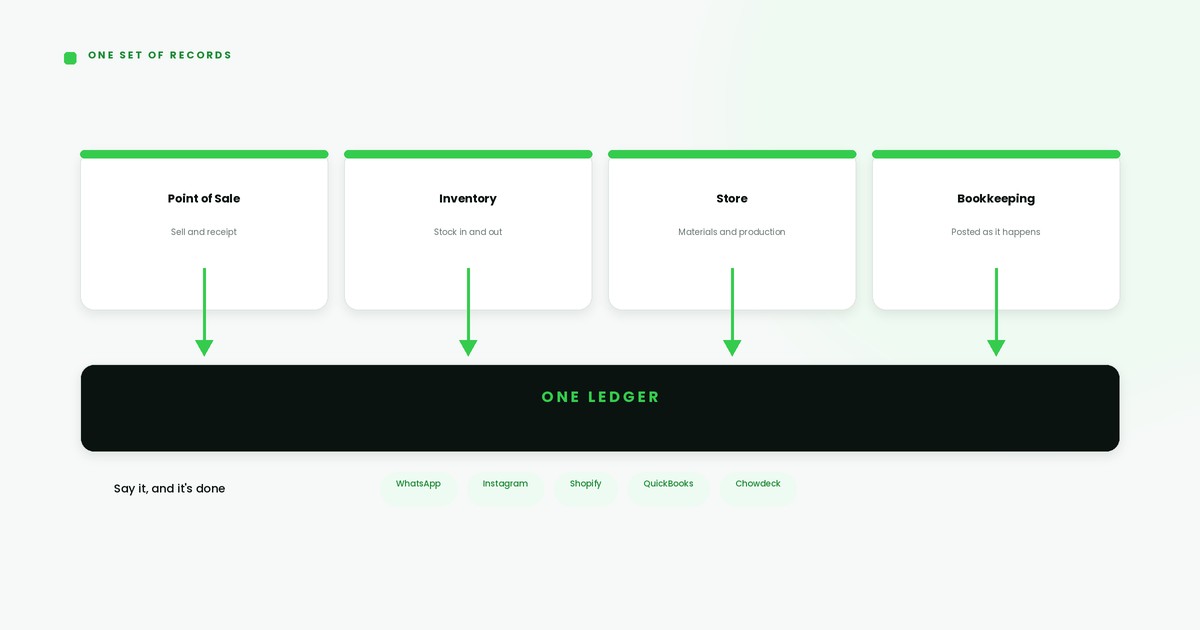
Most small business software fails in the same way. You buy a POS, then a stock app, then a bookkeeping tool, and now you have three systems that each hold a piece of the same sale.
The reconciling does not disappear. It moves to you.
Wayg is built the other way round: Point of Sale, Inventory, Store Management and Bookkeeping on one set of records, so sales, stock, cash and books finally agree. Here is what that means in practice, what it costs, and what it does not do.
Four products, one ledger
The four are not modules bolted together. They write to the same records, which is the whole point.
Point of Sale records the sale: item, quantity, price, payment method, who served. On web, iOS or Android, so the counter can be a phone.
Inventory holds what you have and what it cost. Because the sale and the stock sit on the same records, recording a sale moves the stock. There is no second step and no nightly sync to remember.
Store Management covers the rest of the shop floor: receiving goods from suppliers, transfers between locations, adjustments, and the people doing all of it.
Bookkeeping is what falls out the other end. Revenue comes from the sales, cost of goods sold comes from the purchases those sales consumed, expenses come from what you record. Because the cost side is real rather than assumed, margin is something you can look at on a Wednesday instead of a theory you confirm in June.
The test of a joined system is simple. Sell one carton and ask whether your stock count, your cash position and your books all changed. In Wayg they did, from one action.
The Wayg Assistant: say it, and it is done
The Assistant takes voice or text, in natural language. That is the interface most people actually use, because typing into forms while a customer waits is nobody's idea of a good evening.
"Sold six cartons of the small size at nine thousand five hundred." "How much did we take today?" "What has not sold since September?" "Received twenty bags from Musa, forty two thousand each."
Two things matter about this. The first is that it lowers the cost of entry for staff who will never learn an accounting interface. The second is that it makes the evening catch-up survivable: reading a notebook page aloud at close is a different job from retyping it, and the backlog is what kills most attempts to move off paper. That transition is covered properly in Wayg vs the notebook and calculator.
Assistant use is metered as AI credits, and the allowance goes with your plan, from 60 on Free up to 7,000 on Scale.
One set of records is not a feature. It is the difference between checking your numbers and reconstructing them.
Daily reconciliation and variance detection
This is the part that earns the subscription.
Every day, Wayg reconciles across cash, stock, transfers and books, and flags variances: the places where what should be there and what is there do not match. Cash counted against cash expected. Stock counted against stock expected. Transfers received against sales recorded as transfers.
The value is timing. As an illustrative example: a ₦4,300 difference on one product on a Tuesday is a question you can still answer, because somebody remembers Tuesday. The same ₦4,300 discovered inside a ₦70,000 hole in February is not a question, it is a write-off. Why your stock never matches your records goes through the six usual causes, and most of them are process rather than theft.
The number of variance checks available depends on plan: three on Starter, six on Basic, eleven on Growth, fifteen on Scale.
Roles, permissions and audit trails
A business with staff needs two things software often skips: limits on who can do what, and a record of who did it.
Wayg has team roles with permissions and audit trails. The person receiving goods does not need to be the person who can change a price. The person at the counter does not need to see supplier costs. And when a sale is voided or a quantity adjusted, there is a trace with a name and a time on it.
This is not about assuming the worst of your people. It is about the fact that an unwitnessed count with no trail cannot be checked by anyone, including the person who did it honestly and would like to be able to prove it.
User limits by plan: 1 on Free, 3 on Starter, 5 on Basic, 10 on Growth, 50 on Scale.
What it connects to
Named on the site: WhatsApp, Instagram, Facebook, Telegram, QuickBooks, Shopify, Chowdeck, Bumpa, Glovo, spreadsheets, handwritten notes and websites.
Those fall into three groups. Where orders come from, including the social channels and the delivery platforms. Where you already sell, like Shopify. And where your records already are: spreadsheets and handwritten notes are import sources, which means moving over does not start with retyping a year of history.
QuickBooks deserves its own note. It is a general ledger and an accountant-facing tool, and Wayg is not trying to replace it. The reason to join them is that your accountant gets structured records instead of a photographed notebook page. That argument is in Wayg and QuickBooks: why it is not either/or.
What it costs
Monthly pricing. Annual billing saves 17%.
| Plan | Price/month | AI credits | Product variants | Materials | Users | Customers | Variance checks |
|---|---|---|---|---|---|---|---|
| Free | ₦0 | 60 | 50 | 50 | 1 | 50 | None |
| Starter | ₦5,000 | 200 | 100 | 100 | 1 | 150 | 3 |
| Basic (recommended) | ₦15,000 | 1,000 | 500 | 500 | 5 | 700 | 6 |
| Growth | ₦25,000 | 2,500 | 1,000 | 1,000 | 10 | 1,500 | 11 |
| Scale | ₦50,000 | 7,000 | unlimited | unlimited | 200 | unlimited | 15 |
Annual equivalents quoted on the site: Starter ₦50,000/yr, Basic ₦150,000/yr, Growth ₦250,000/yr, Scale ₦500,000/yr.
Every plan includes POS, Inventory, Store Management, Bookkeeping, the Wayg Assistant, the mobile app and the integrations. The plans differ in volume and in how many people and checks you get, not in which products you are allowed to use.
What Wayg is not
This list is deliberate, because a comparison you can trust is one that includes the rows that do not flatter us.
Wayg is not a bank and does not hold your money. It is not a payment gateway and does not process card or transfer payments, so keep your terminal; the case for that is in why a POS on its own still leaves you reconciling. It does not run payroll. It does not lend and it has no credit product. It does not file returns to the revenue service, does not do e-invoicing clearance, and holds no accounting certification. It does not give tax advice. Nothing in this post is tax advice either, so confirm any figure, deadline or treatment with a tax adviser or the revenue service.
What it does is keep one complete, dated, searchable set of records of what your business actually did, which is the input every one of those other things needs.
Frequently asked questions
Who is this business management software Nigeria shops use actually built for?
Retail shops, food and beverage, fashion and beauty, service businesses, producers and makers, wholesalers and distributors, at sizes from solo to enterprise. The common factor is stock or jobs plus money, in more than one place.
Do I need to be online to use it?
Yes, it needs a connection, and that is an honest limitation compared with a notebook. The practical answer in a shop where light and network both go is to write at the counter during an outage and enter the day at close.
How do I move my existing records over?
Wayg imports from spreadsheets and handwritten notes. The order that works is one product list with prices and costs, then one real stock count on day one so your opening position is true, then daily trading from there.
Is the free plan a trial?
It is a plan, not a countdown. Free covers one user, 50 product variants, 50 customers and 60 AI credits, with no card needed to start.
Run it on your own records for a week
Do not judge it on a demo. Import your product list, trade a normal week, and on Saturday compare the app's numbers with your own. If they disagree, the disagreement itself is the useful part, because that gap has been there all along.
Get started freeThe free plan needs no card.