BlogBooks
Pricing so that you actually make money
Markup is not margin, and confusing the two is quietly costing Nigerian shops real money. Here is the maths, with a conversion table.
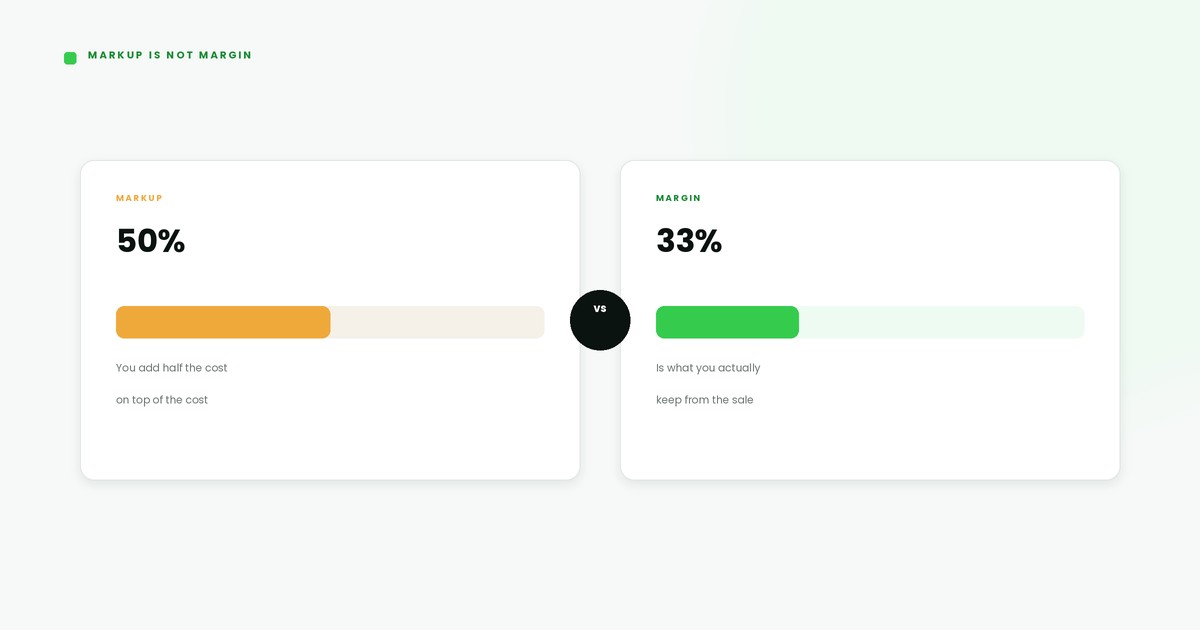
Ask a shop owner what margin they make and most will say something like "I add twenty percent." Then ask what percentage of sales that twenty percent is, and the room goes quiet.
It is 16.7%. Not 20%. That gap is small on one carton and enormous across a year.
This is the most expensive arithmetic error in Nigerian retail, and it takes about four minutes to fix permanently.
Markup and margin are different numbers
Both describe the same gap between cost and price. They just divide by different things.
Markup % = (Selling price − Cost) ÷ Cost × 100. You are measuring against what you paid.
Margin % = (Selling price − Cost) ÷ Selling price × 100. You are measuring against what you sold for.
Cost ₦1,000, price ₦1,200. Markup is 200 ÷ 1,000 = 20%. Margin is 200 ÷ 1,200 = 16.7%. Same transaction, two numbers.
It matters because every cost you have to cover (rent, salaries, diesel, transport) is compared against sales, not against cost of goods. So margin is the number that pays your bills, and markup is the number you type into a calculator at the counter.
The conversion table to keep at the till
Margin = markup ÷ (1 + markup). Rather than do that at the counter, use this.
| Markup on cost | Margin on selling price |
|---|---|
| 10% | 9.1% |
| 15% | 13.0% |
| 20% | 16.7% |
| 25% | 20.0% |
| 30% | 23.1% |
| 33.3% | 25.0% |
| 40% | 28.6% |
| 50% | 33.3% |
| 60% | 37.5% |
| 75% | 42.9% |
| 100% | 50.0% |
| 150% | 60.0% |
Read it the other way when you are setting prices, which is the more useful direction. If you need a 30% margin, you need roughly a 43% markup. The formula is:
Selling price = Cost ÷ (1 − target margin).
Cost ₦9,000 at a 30% target margin: ₦9,000 ÷ 0.70 = ₦12,857.
Nobody goes broke on a bad price. They go broke on a good price applied to the wrong cost.
Cost means landed cost, not the invoice
Here is where the real money leaks. The number you price off is almost never the number on the supplier's invoice.
Landed unit cost = (invoice + transport + handling + charges) ÷ units actually saleable.
Illustrative example, not a benchmark or a market rate. A shop buys noodles at the market:
| Line | Amount |
|---|---|
| 100 cartons at ₦8,500 | ₦850,000 |
| Transport to the shop | ₦35,000 |
| Loading and offloading | ₦6,000 |
| Bank transfer charge | ₦1,000 |
| Total cash out | ₦892,000 |
| Cartons damaged in transit | 2 |
| Saleable cartons | 98 |
Landed unit cost: ₦892,000 ÷ 98 = ₦9,102.
The owner has ₦8,500 in their head. The true cost is ₦9,102, which is 7.1% higher.
Now watch what that does. Sell at ₦9,500 and the owner believes the margin is (9,500 − 8,500) ÷ 9,500 = 10.5%. The actual margin is (9,500 − 9,102) ÷ 9,500 = 4.2%.
To genuinely hit an 18% margin on that carton, the price is ₦9,102 ÷ 0.82 = ₦11,100. Not ₦9,500. Whether the market will bear ₦11,100 is a separate and harder question, but at least it is now the right question.
Diesel is not an afterthought, it is a cost per unit sold
Rent, salaries and diesel do not appear in landed cost. They sit below gross profit, and gross margin has to be big enough to cover them.
Illustrative example. Monthly fixed costs:
| Cost | Monthly |
|---|---|
| Rent | ₦150,000 |
| Salaries | ₦180,000 |
| Diesel, ₦12,000 a day across 26 trading days | ₦312,000 |
| Other (airtime, waste, repairs, bank charges) | ₦58,000 |
| Total | ₦700,000 |
Break-even sales = fixed costs ÷ gross margin %.
At an 18% gross margin: ₦700,000 ÷ 0.18 = ₦3,888,889 of sales a month just to stand still. At 25%: ₦2,800,000. At 12%: ₦5,833,333.
That is the whole business model on one line. Six points of margin, from 12% to 18%, cut the break-even by ₦1,944,444 of monthly sales. The next seven points, from 18% to 25%, cut it by a further ₦1,088,889. If you are working from a monthly close that gives you a real gross margin figure, you can run this calculation every month in thirty seconds.
Repricing when supplier prices move
Nigerian supplier prices do not move gently, and the instinct to "finish the old stock at the old price first" is the instinct that hollows out a business.
Price off replacement cost, not historic cost. The question is not what you paid for the carton on the shelf. It is what it will cost to put another carton there. If you sell at the old price and the new landed cost is 12% higher, you have sold the goods and funded a shortfall on the restock.
A workable rule for a small shop:
1. Recalculate landed cost on every delivery, not every invoice. Delivery is when transport and damage are known.
2. Reprice when landed cost moves more than 3%. Below that, absorb it and watch. Above it, move.
3. Review your top 20 lines by value weekly. In most shops those lines are the majority of the money. The long tail can wait for the monthly close.
4. Reprice in steps, not in leaps. Two 6% moves three weeks apart are absorbed. One 13% move gets noticed and resented.
5. Keep your margin target fixed and let the price float. The target is the decision. The price is just arithmetic on the target.
One more habit worth building: when a supplier gives you a discount for volume, put the discount into landed cost rather than into your pocket as a win. A ₦200 per carton discount on 100 cartons is ₦20,000 of margin only if you actually recompute and do not quietly drop your price by ₦250 to move the stock.
And if a line has sat unsold for months, it is not a pricing problem. It is dead stock, and it needs a different decision.
Frequently asked questions
What is the difference between markup and margin?
Markup is profit as a percentage of cost. Margin is profit as a percentage of the selling price. A 20% markup is a 16.7% margin. Margin is the number that has to cover rent, salaries and diesel, so it is the one to manage.
How do I calculate landed cost?
Add the invoice, transport, handling, and bank or transfer charges, then divide by the units that are actually saleable after damage. In the example above, ₦892,000 across 98 good cartons gives a landed cost of ₦9,102, not the ₦8,500 on the invoice.
How often should I reprice in Nigeria?
Recalculate landed cost on every delivery and reprice when it has moved more than about 3%. Review your top 20 lines by value weekly. Waiting for a quarterly review means selling below replacement cost for weeks without knowing it.
What gross margin should a Nigerian shop aim for?
There is no single credible published figure across trades, so be wary of anyone who gives you one. Work backwards instead: take your monthly fixed costs, divide by your realistic sales, and that is the gross margin you need before you have made a naira.
Price off the cost you can actually see
Wayg keeps point of sale, inventory, store management and bookkeeping on one set of records, so landed cost, selling price and realised margin all come from the same place. Ask the Wayg Assistant, by voice or text, what your margin was on a line last month, and you get an answer rather than an estimate.
Get started freeThe free plan needs no card.
This article is general information rather than financial advice, and every naira figure in it is an illustrative example rather than a benchmark. Run the same calculations on your own costs before you change a single price.