BlogBooks
What records a Nigerian business actually has to keep
The eight records a Nigerian shop should be able to produce on demand, and the two numbers that decide whether you are a small company.
A woman in Surulere with two provisions shops can tell you, from memory, what a carton of milk cost her last Tuesday. She cannot tell you what her turnover was last year. Not because she is careless, but because nobody ever asked her to add it up.
From 1 January 2026 somebody does ask. The Nigeria Tax Act 2025 hands small companies a 0% Companies Income Tax rate, and it defines "small" by two numbers you can only produce from records.
The relief is generous. The proof is on you.
The two numbers that decide everything
Under the Nigeria Tax Act 2025, a small company is one with turnover of ₦50 million or less and fixed assets of ₦250 million or less, per EY's alert on the Act. Businesses providing professional services are excluded from the definition.
Read that as a test with two locks. Failing either one takes you out. And "turnover of ₦50 million or less" is not a feeling about how the year went. It is a figure that has to come from somewhere.
If your sales live half in a POS terminal, half in transfer alerts on a phone and half in a notebook (yes, three halves, that is the problem), you cannot produce that figure to a standard anyone will accept. The 0% rate is not the hard part. Substantiating it is.
What the law expects you to be able to show
The same reforms are clear that 0% CIT is not 0% obligation. Per AO2 Law's overview of small company taxation under the new regime, a small company must still hold a valid Tax Identification Number, keep records that substantiate turnover and fixed assets, obtain withholding tax credit certificates, file VAT returns where applicable, and operate PAYE on staff salaries.
Every single item on that list is a record-keeping requirement wearing a different hat.
A 0% tax rate you cannot evidence is not a 0% tax rate. It is an argument you are going to lose.
The withholding tax exemption works the same way. AO2 Law notes it applies to small companies that hold a valid TIN and whose monthly transactions do not exceed ₦2 million. That is a monthly test, which means it is a monthly record.
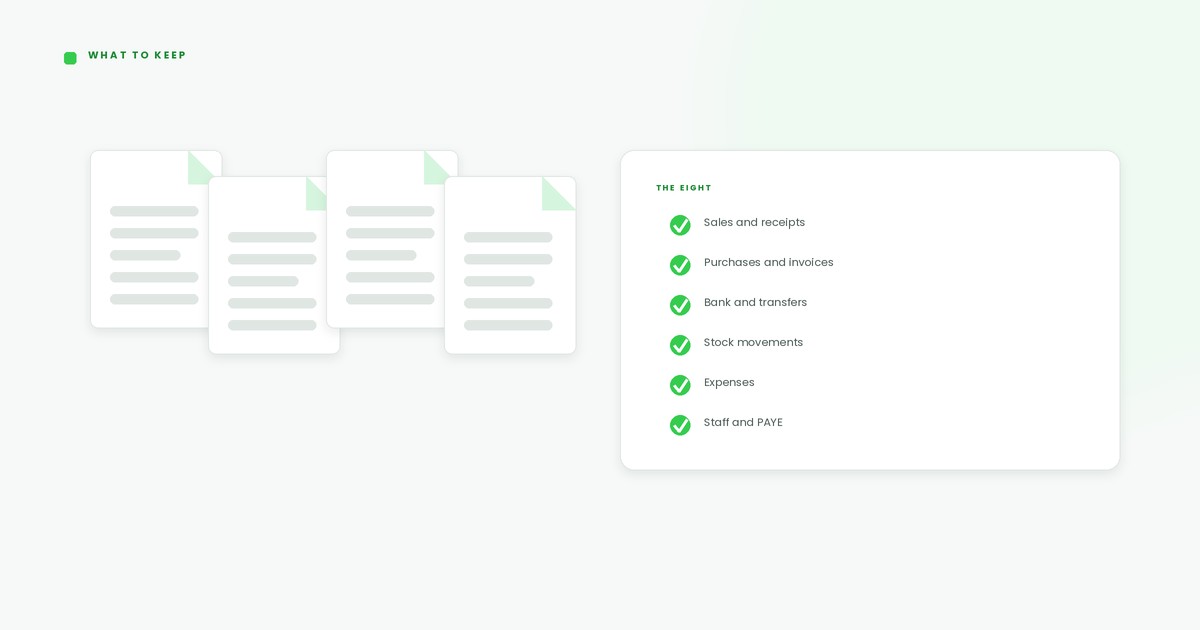
The eight records a shop should have
Not a filing cabinet. Eight things, each of which answers a question somebody will eventually ask.
| # | Record | What it proves | Minimum detail | How often |
|---|---|---|---|---|
| 1 | Daily sales record | Turnover, and the ₦50m test | Date, gross sales, split by cash, transfer and card | Every trading day |
| 2 | Cash book | That cash in the drawer matches cash recorded | Opening float, takings, payouts, closing count | Every trading day |
| 3 | Bank and POS settlement statements | That money actually arrived | Statement plus terminal settlement report | Monthly, downloaded |
| 4 | Purchase invoices and goods received notes | Cost of sales, and input VAT | Supplier, date, quantity, unit price, VAT shown | Every delivery |
| 5 | Stock movement and count records | Closing stock, and shrinkage | Opening, receipts, sales, adjustments, counted figure | Continuous, counted monthly |
| 6 | Expense receipts | Deductible costs: rent, diesel, transport, repairs | Date, payee, amount, what it was for | As incurred |
| 7 | Payroll and PAYE file | That PAYE was operated and remitted | Staff list, gross pay, deductions, remittance evidence | Monthly |
| 8 | Debtor and creditor ledger, with WHT credit certificates | Who owes you, who you owe, tax already suffered | Name, amount, date, age, certificate copies | Weekly review |
If you can produce those eight on demand, almost every question a revenue officer, a bank or a buyer asks has an answer already sitting in a folder.
The fixed assets half nobody keeps
Turnover gets attention because it is money moving. Fixed assets get ignored because they sit still.
The ₦250 million fixed asset limit means you need a fixed asset register: every generator, freezer, delivery van, shelving unit and counter, with the date bought, what it cost and the invoice. Most shops have none of this. They have a freezer and a vague memory of the year they bought it.
An illustrative example, not a benchmark: a small distributor with ₦46 million turnover buys a ₦9 million truck in March and a ₦2.4 million generator in August. Without a register, the owner has no running total and no idea how close either number is to its limit. With one, both numbers are a glance.
How long to keep things
We are deliberately not going to quote you a statutory retention period, because that is exactly the kind of number people repeat wrongly and then rely on. Confirm the statutory minimum with your tax adviser or the revenue service.
What we will give you is the practical floor, and you can work it out from the filing calendar. Companies income tax for a company with a December year end is due 30 June 2026, per Taxly's 2026 deadline guide. So a record from January 2026 is still supporting a return filed eighteen months later, and that return can be queried after it is filed.
Treat anything that supports a filed return as live until well past that. Scan or photograph paper the day it arrives, because thermal receipts for diesel and transport fade to blank within months, and a faded receipt is the same as no receipt.
Start with the record that unlocks the others
If you only fix one thing, fix the daily sales record, because records 1, 3, 5 and 8 all feed off it. A day's sales tells you what left the shelf, what should be in the drawer, what should hit the bank and what went out on credit.
That is the whole argument for keeping sales, stock, cash and books on one set of records instead of four. Four sets do not disagree because anyone is dishonest. They disagree because nobody has time to reconcile four things by hand every night. Our guide to closing your books every month turns that into a seven-step routine, and who should see what covers who is allowed to touch which record along the way.
Frequently asked questions
Do I need to keep records if I am not registered with CAC?
Yes, as a practical matter. You still have a personal income tax position, you still need to know what you earned, and you cannot register later without a credible history. Confirm what applies to your specific status with a tax adviser.
What counts as turnover for the ₦50 million small company test?
Turnover is your sales, not your profit and not what stayed in the bank. EY's summary of the Nigeria Tax Act 2025 sets the small company test at turnover of ₦50 million or less and fixed assets of ₦250 million or less. Confirm how it is computed for your business with your adviser.
Is a notebook acceptable as a business record?
A notebook that is complete, dated and consistent is far better than nothing. The problem is that it cannot be totalled quickly, cannot be cross-checked against a bank statement, and does not survive water, fire or a departing staff member.
Do I need a separate business bank account?
It is not something we can state as a legal requirement here, but mixing personal and business money makes turnover almost impossible to substantiate. If school fees and stock purchases leave the same account, every figure you produce is arguable.
Get your eight records into one place
Wayg keeps point of sale, inventory, store management and bookkeeping on one set of records, so sales, stock, cash and books finally agree, and daily variance detection tells you when they do not. That is the difference between having records and being able to prove something with them.
Get started freeThe free plan needs no card.
This article is general information, not tax advice. Tax rules, figures and dates change, and the 2026 reforms are new. Confirm every figure and deadline here with a qualified tax adviser or the relevant revenue service before you act on it.
Sources: EY: Nigeria Tax Act, 2025 has been signed · AO2 Law: Taxation of small companies under the new tax regime · Taxly: Tax Filing Deadlines Nigeria 2026