BlogStock
Dead stock: how to spot it and what to do about it
Define dead stock by days since last sale, price what it costs you, then pick one of five exits and take it.
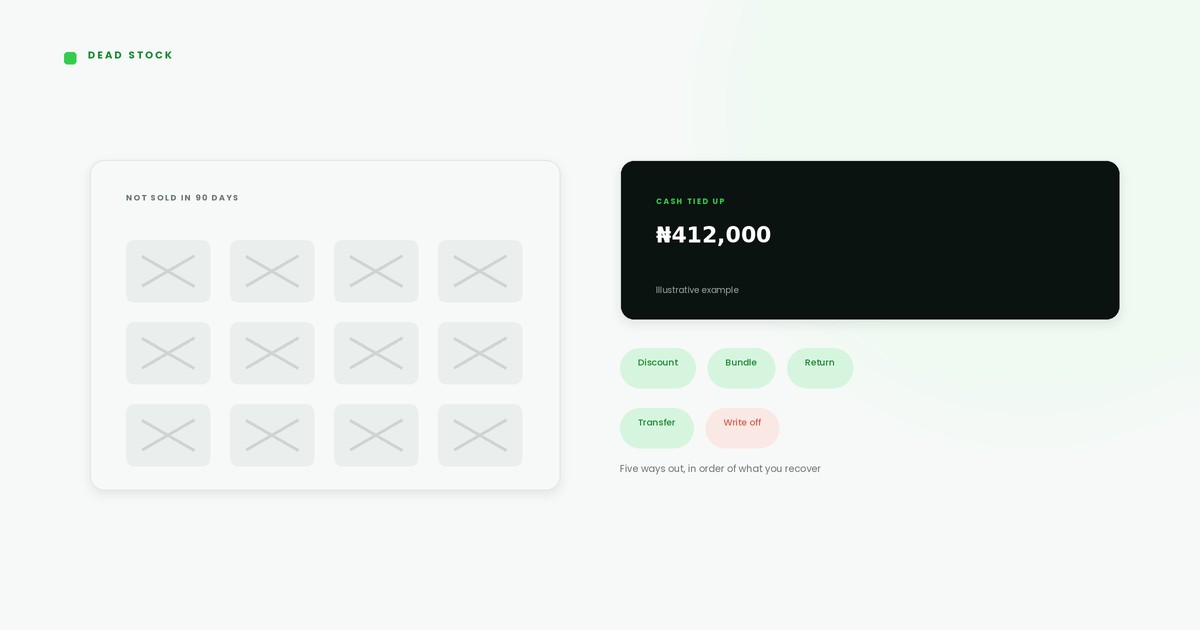
There is a shelf at the back of your shop you have stopped seeing. Four cartons of a body spray nobody asked for since June. A box of chargers for a phone model that has moved on. Two cases of a drink your supplier talked you into.
You know it is there. You also know that selling it at a loss feels like admitting you were wrong, so it stays.
It is already a loss. The only question left is how much more of it you want to fund.
Define it with a date, not a feeling
Dead stock is stock with no sales in a defined window. Slow stock still sells, just below the rate that justifies its shelf space. Obsolete stock will never sell again because it expired, broke, or the model changed.
Pick one threshold per category and apply it without sentiment. These are working thresholds, not published standards, and you should tighten them if your cash is tight.
| Category | Dead if no sale in | Why that window |
|---|---|---|
| Fresh and perishable | 7 days | You are managing expiry, not sales rate |
| Fast consumables: drinks, snacks, provisions | 60 days | Six restock cycles with no movement is a verdict |
| General household and hardware | 90 days | Normal purchase cycles are monthly or shorter |
| Fashion and beauty | 120 days, or one full season past | Season is the real clock, not the calendar |
| Phone and electronics accessories | 120 days | Models turn over and compatibility dies |
| Spare parts and genuinely slow lines | 365 days | Slow by design, so judge on holding cost instead |
Run the list monthly with three columns: item, days since last sale, and value at cost. Sort by value, not by days. Twelve dead sachets do not matter. One dead generator does.
Price what it is costing you
Dead stock does not sit still and cost nothing. It costs you four things at once, and the biggest one is invisible.
Illustrative example. The figures are made up to show the method.
A shop is holding ₦1,200,000 at cost in items with no sale in 90 days.
- Tied-up cash. That ₦1,200,000 would otherwise be buying goods that sell. If your working capital turns over six times a year at a 25% gross margin, the same money spent on live stock earns 1,200,000 × 6 × 0.25 = ₦1,800,000 of gross profit a year. That is the real cost, and it dwarfs everything else on this list.
- Space. If the dead stock occupies a fifth of your storeroom and your rent is ₦600,000 a year, you are paying ₦120,000 a year to store goods that generate nothing.
- Decay. Packaging fades, rats find it, damp gets in, expiry dates pass. Some portion becomes unsellable every month it stays.
- Attention. It gets counted at every stock count and read at every reorder review, making both slower and noisier.
Dead stock is not a shelf problem. It is your working capital, sitting down.
Five exits, in the order you should try them
Work down the list. Each step recovers less cash than the one above it, so do not jump to the bottom because it is emotionally easier.
1. Discount, on a ladder. Do not go straight to half price. Set fixed dates in advance: 15% off for 30 days, 30% for the next 30, 50% after that. Put it at the counter or by the door, not back where it died. Any price above your handling cost recovers cash you do not currently have.
2. Bundle it with something that sells. Attach the slow item to a fast mover and price the pair so the blended margin still works. A dead body spray goes with a moving soap at a combined price that beats the soap alone. Customers buy the deal, and you clear the shelf without publishing a markdown that trains people to wait for one.
3. Return it to the supplier. Ask, and ask early. Distributors often prefer a swap to a refund, and a swap suits you because you trade dead value for live value at cost. Return windows are short, which is the whole argument for reviewing monthly rather than annually.
4. Transfer it to your other shop. Check the other location's sales rate for that item first. Moving dead stock from Surulere to Yaba only helps if Yaba sells it. Record the transfer on both sides with a date and a receiving signature, or you create a variance you spend next quarter investigating.
5. Write it off. Last, and only when the item is expired, damaged, unsellable or genuinely unwanted at any price you would accept.
| Situation | Exit to take first |
|---|---|
| Still sellable, just slow | Discount ladder |
| Sellable but nobody asks for it | Bundle with a fast mover |
| Bought recently, supplier relationship good | Return or swap with supplier |
| Sells elsewhere in your business | Transfer, after checking the other shop's rate |
| Expired, broken, or superseded | Write off |
How to write off so the books stay honest
A write-off is not deleting the item, and it is not quietly editing the quantity until the shelf and the screen agree. That is how a real loss becomes an invisible one.
Do it as a recorded adjustment with five pieces of information: the item, the quantity, the value at cost not at selling price, the reason code, and the name of the person who approved it. Approval should sit with someone other than whoever handles the stock.
Use reason codes you can count later: expired, damaged, obsolete, theft suspected, unexplained. Those categories are what tell you next year whether you have a buying problem, a storage problem or a shrinkage problem.
Keep evidence: a photo of the expired batch, the disposal note, the date, two signatures. That is the difference between a documented business loss and an unexplained hole.
Write off in the month it happened, not in one lump at year end. Inventory is an asset on your books, and a write-off moves that value out of the asset and into your costs, reducing profit in the period you post it. Twelve months of write-offs posted in December makes December look like a disaster and the other eleven months look better than they were. Neither picture is true.
Once a quarter, total the write-offs by reason code against purchases. If obsolete write-offs keep rising, the problem is upstream in buying, and reorder points will do more for you than any clearance sale.
Frequently asked questions
How do I know if stock is dead or just slow?
Set a threshold in days per category and apply it to every item. Zero sales inside the window is dead, sales below the rate that pays for its shelf space is slow, and the two need different answers.
Should I sell dead stock below cost?
Usually yes. The money you paid is already spent and waiting will not bring it back. Any price above your cost of handling the sale converts a dead asset into cash you can spend on stock that moves.
Should I write off dead stock or just leave it on the books?
Leaving it inflates the value of your stock and flatters your accounts, which means every decision you make from those numbers is made on a false figure. Write it off in the month you accept it is dead, and keep the evidence of what went and why.
How often should I review for dead stock?
Monthly. Returns windows close, expiry dates pass, and seasonal goods lose value fast, so an annual review finds problems too late to do anything but write them off.
See the dead shelf before it gets expensive
Every naira figure in this article is an illustrative example rather than a benchmark. Work the same calculations on your own numbers.
Wayg is built to flag days since last sale on every item and value what is sitting still, so your monthly dead stock list builds itself. Discounts, bundles, transfers and write-offs all post to the same set of records, which means your stock, your margin and your books stay in agreement afterwards.
Get started freeThe free plan needs no card.