BlogStock
Reorder points without the maths degree
Average daily sales times lead time, plus a buffer. One formula, an honest view of Nigerian lead times, and a worked example.
You ran out of Bournvita on a Saturday morning. Three customers asked, three customers walked to the shop opposite, and one of them will now do her weekly shopping there.
You did not run out because you were careless. You ran out because you reorder when the shelf looks empty, and by the time a shelf looks empty it is already too late for a supplier who takes five days.
A reorder point fixes that with one line of arithmetic. No forecasting, no software degree.
The whole formula
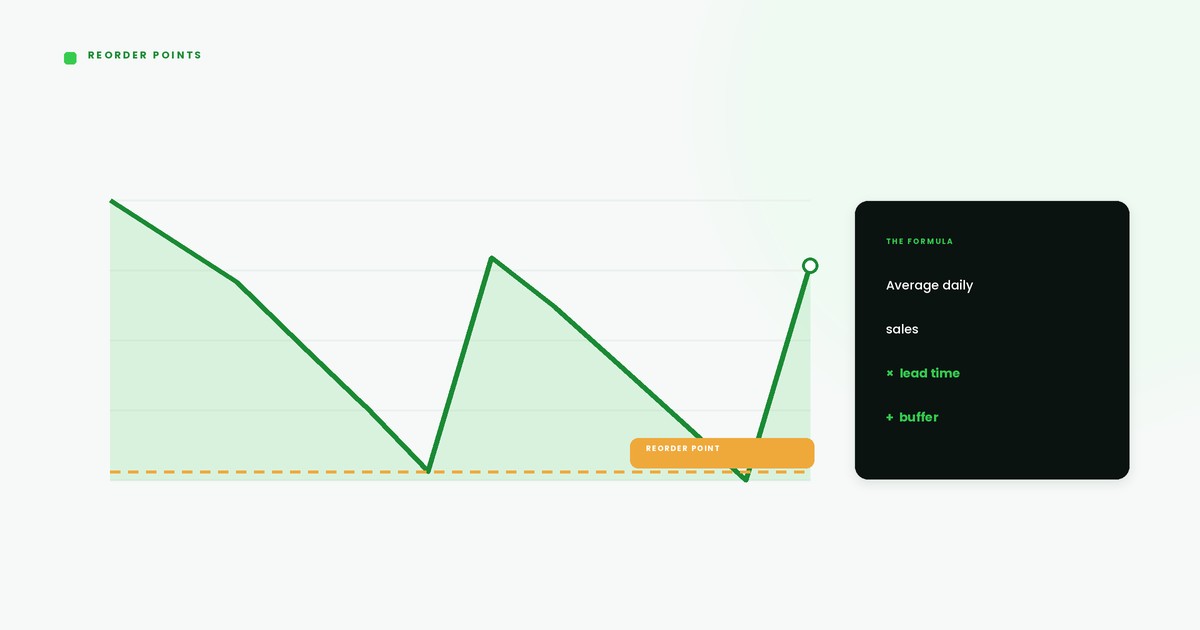
Reorder point = average daily sales × lead time in days + safety buffer
That is it. When stock on hand falls to that number, you order. Not before, not when the shelf looks thin.
Notice what the formula does not tell you: how much to order. That is a separate decision driven by your cash, your storage and your supplier's minimum. The reorder point answers when. Keep the two questions apart and both get easier.
Average daily sales, measured not remembered
Use 8 weeks of actual sales. Not last week, because last week may have had a holiday. Not six months, because your prices and your street have both changed.
Average daily sales = units sold in last 56 days ÷ 56
Two adjustments are worth making. Divide by the days you actually traded, not 56, if you closed for any of them. And if one customer bought a strange bulk quantity for a party, exclude that line and note why, or the single event inflates your reorder point for two months.
Lead time, told honestly
This is where most reorder points go wrong in Nigeria. Lead time is not what your supplier says. It is the number of days from the moment you decide to order to the moment the goods are priced and on the shelf where a customer can buy them.
That clock includes the parts nobody writes down. Getting the money together. The trip to Trade Fair or Balogun and the queue when you arrive. The supplier being out of your size and offering you next week. Transport, unloading, pricing and shelving. Sundays and public holidays, which count as days even though nothing moves.
So measure it yourself. Write down the order date and the shelf-ready date for your last six orders per supplier.
| Order | Order date | Shelf-ready | Lead time |
|---|---|---|---|
| 1 | 3 Aug | 6 Aug | 3 days |
| 2 | 17 Aug | 21 Aug | 4 days |
| 3 | 31 Aug | 6 Sep | 6 days |
| 4 | 14 Sep | 18 Sep | 4 days |
| 5 | 28 Sep | 7 Oct | 9 days |
| 6 | 12 Oct | 16 Oct | 4 days |
Average 5 days. Worst 9 days. Both numbers matter, and the gap between them is your risk.
Your supplier's promise is marketing. Your last six deliveries are data.
The safety buffer
The buffer protects against two things going wrong at once: selling faster than usual, and the delivery taking longer than usual. In Nigerian supply, the second is almost always the bigger risk, so set the buffer off the lead time gap.
Safety buffer = average daily sales × (worst lead time − average lead time)
If your worst delivery ran four days longer than your average, you carry four days of sales as a cushion. It comes from your own history, and it shrinks automatically when a supplier becomes reliable.
Two shortcuts if you have not logged six orders yet. For a steady seller, carry about a quarter of your lead time demand. For anything volatile, seasonal, or supplied by one person who sometimes disappears, carry half.
A worked example
Illustrative example only. These figures are made up to show the method, not researched benchmarks.
A provisions shop in Surulere, one item: Bournvita 500g refill.
- Units sold in the last 56 days: 420
- Average daily sales: 420 ÷ 56 = 7.5 units
- Average lead time from the table above: 5 days
- Worst lead time: 9 days
Lead time demand: 7.5 × 5 = 37.5, round up to 38 units.
Safety buffer: 7.5 × (9 − 5) = 30 units.
Reorder point = 38 + 30 = 68 units.
The supplier sells in cartons of 12, so 68 units is about 5.7 cartons. Round the trigger up, never down: reorder when stock hits 6 cartons. If that feels like a lot of Bournvita sitting on a shelf, remember the alternative is the Saturday morning you already had.
Reorder points for a handful of items
Illustrative example. Your own numbers will differ.
| Item | Avg daily sales | Avg lead time | Worst lead time | Buffer | Reorder point |
|---|---|---|---|---|---|
| Bournvita 500g refill | 7.5 | 5 days | 9 days | 30 | 68 units |
| Peak Milk 400g tin | 14 | 4 days | 6 days | 28 | 84 units |
| Indomie Chicken 70g (pack) | 60 | 3 days | 5 days | 120 | 300 packs |
| Sachet water (bag) | 22 | 2 days | 3 days | 22 | 66 bags |
| Dettol 250ml | 2 | 7 days | 14 days | 14 | 28 units |
Read the Dettol line closely. It barely sells, but the supplier is slow and unpredictable, so its reorder point is fourteen days of sales. Slow movers with unreliable supply need proportionally the biggest buffers, which is the opposite of what instinct says.
Reviewing them, because they go stale
A reorder point set in March is wrong by August. Put the review on a rhythm rather than waiting for a stockout to remind you.
- Monthly: recalculate average daily sales on the rolling 56 days. Anything that moved more than 20% gets a new reorder point.
- Every order: log the lead time. Six entries in, recalculate that supplier's buffer.
- After a price change: yours or a competitor's, because demand moves with it.
- Before a season: December, Ramadan, back to school, harvest. Set the seasonal reorder point two lead times before the season starts, not on the first busy day.
- After a supplier change: restart the lead time log from zero and use a generous buffer until it has history.
Watch the other direction too. If an item keeps hitting its reorder point but never runs low, your buffer is too fat and that is cash sitting on a shelf. If it runs to zero before the delivery lands, your lead time is understated. Items that never move at all are a different problem, and belong in the dead stock conversation.
Frequently asked questions
What is the reorder point formula?
Average daily sales multiplied by lead time in days, plus a safety buffer. Stock on hand falling to that number is your signal to place the order.
How do I set a reorder point for a brand new product?
You cannot, for the first month, because you have no sales history. Order small, count weekly, and set a real reorder point once you have four to eight weeks of sales.
Does the reorder point tell me how much to order?
No. It only tells you when. Order quantity depends on your cash, your supplier's minimum, your storage and your discount for buying more, and it is a separate calculation.
Should I include stock that is already on order?
Yes. Compare the reorder point against stock on hand plus stock already ordered but not delivered, or you will order the same thing twice and turn a stockout into a pile.
Let the shelf tell you before the customer does
Wayg works out average daily sales from your own till, tracks how long each supplier really takes, and raises the reorder alert while there is still time to act. Same records as your sales, your stock counts and your books, so the numbers never have to be re-entered.
Get started freeThe free plan needs no card.