BlogComparisons
Wayg and QuickBooks: why it is not either/or
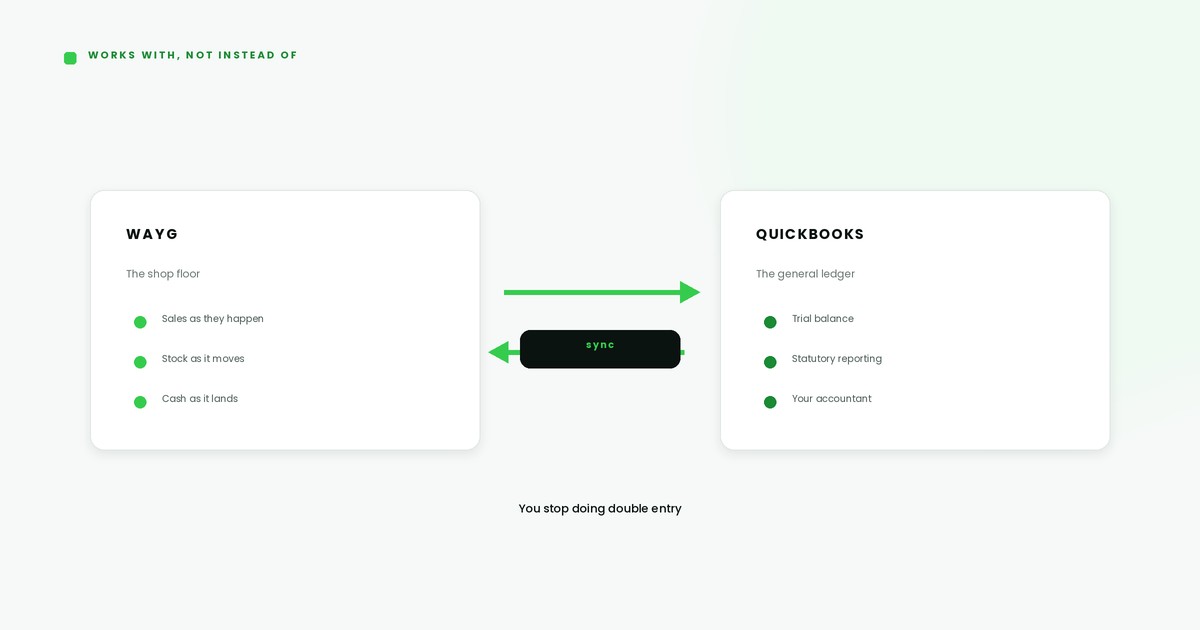
QuickBooks is a general ledger. Wayg is where the shop floor happens. The useful question is not which one, but where the join is.
Ask a shop owner with an accountant what happens at month end and you get some version of the same answer: "I send him the sales, he does the books."
Then ask what "send him the sales" means. It is usually a photograph of a notebook page, a spreadsheet, a bank statement and a phone call about the four things that did not make sense.
The accountant is not the problem and neither is his software. The gap is between the counter and the ledger, and it is being crossed by hand.
Two different jobs that get confused
QuickBooks is a general ledger. Its job is to hold the double entry, classify transactions into accounts, produce a profit and loss and a balance sheet, handle the chart of accounts, and give a professional something they can work in and sign off. It is built for accountants, and accountants know it.
Wayg is an operating system for the business itself: Point of Sale, Inventory, Store Management and Bookkeeping on one set of records, so sales, stock, cash and books agree. Its job is what happens between eight in the morning and eight at night, at a counter, on a phone, with staff.
Those are not the same job and neither one does the other well. A ledger will not tell your boy at the counter whether the small size is still in stock. A shop floor system is not where your accountant wants to prepare a year end.
The question is not which system you keep. It is where the join between them lives, and whether a human is it.
Which questions each one answers
| Question you are actually asking | Answered by |
|---|---|
| Do we still have the 50cl in the small fridge? | Wayg |
| What did we take today, and does the cash agree? | Wayg |
| Which products have not moved in 60 days? | Wayg |
| Who voided that sale at 4pm and why? | Wayg |
| What is our true cost per unit on this batch? | Wayg |
| What is the profit and loss for the year to date? | QuickBooks |
| What does the balance sheet look like for the bank? | QuickBooks |
| Which account does this expense belong in? | QuickBooks |
| Is the double entry correct and can it be signed off? | QuickBooks |
| Will either one file my returns to the revenue service for me? | Neither. Your adviser does that |
That last row is deliberate. Wayg does not submit anything to the tax authority, does not run payroll, is not a bank, is not a lender and has no e-invoicing clearance. It keeps records. What you or your adviser do with them is a separate, human step.
Who touches which
This is the part that decides whether a setup works in practice.
The people who touch Wayg are the ones in the business: you, your counter staff, a store person receiving goods, a manager who checks the day's variance. Some of them will never open a laptop. That is why it runs on web, iOS and Android, and why the Wayg Assistant takes voice or text in plain language rather than requiring somebody to learn an accounting interface.
The person who touches QuickBooks is your accountant, and possibly you once a month. Giving counter staff access to a general ledger is how a chart of accounts gets ruined. Nobody wants that, including them.
Wayg handles the access side with team roles, permissions and audit trails, so the person receiving stock is not the same person who can edit a price, and both leave a trace. The number of users depends on the plan: 1 on Free, 3 on Starter, 5 on Basic, 10 on Growth, 50 on Scale.
What the integration is for
QuickBooks is named on the Wayg site as an integration, alongside WhatsApp, Instagram, Facebook, Telegram, Shopify, Chowdeck, Bumpa, Glovo, spreadsheets, handwritten notes and websites.
The point of a join between a shop system and a ledger is always the same: the transaction is captured once, where it happens, and travels to the ledger classified rather than being retyped from a photograph. The shop floor is the source of truth for what was sold and what it cost, and the ledger is the source of truth for how it is presented.
What that removes, concretely:
The retyping. If the sales are already structured, nobody is reading a notebook page aloud over the phone at month end.
The estimated cost of goods sold. Because purchases and sales meet in Wayg, the cost figure arriving in the books is the one from the actual purchase records, not a percentage somebody assumed.
The reconciliation argument. Most month end calls between an owner and an accountant are about a difference neither can explain. When the variance was already flagged the day it happened, that call gets short.
Confirm the specifics of connecting your QuickBooks account, which fields map where and how often it syncs, with Wayg before you plan your month end around it. Integration behaviour is the sort of detail that should come from the setup screen, not a blog post.
What still sits outside both systems
The join does not change what you owe or when you owe it. Filing, remittance and statutory reporting are your accountant's territory and your obligation, and neither Wayg nor QuickBooks removes them.
What good records do is make those moments survivable. When the deadline arrives, the question is never whether the software knows the rule. It is whether you can produce a clean, dated, complete set of figures without spending three days rebuilding them. That is the part this pairing actually solves, and it is worth being precise that it is only that part.
A setup that works
If you already have QuickBooks and an accountant you trust, do not move your ledger. Change what feeds it.
Put the shop floor into Wayg first: products, prices, opening stock from one real count, then daily sales and goods received. Run it for a full month before you connect anything, so that the data arriving in the ledger is data you already believe.
Then connect QuickBooks and let your accountant look at one month of output before you rely on it. Ask him one question: "is this easier or harder to work with than what I sent you last month?" If it is harder, something is mapped wrong and it is better to find that in December than in June.
Keep the division of labour clear after that. You own what happened. He owns how it is presented. Neither of you should be doing the other's typing.
Frequently asked questions
Do I have to choose between Wayg and QuickBooks?
No. They do different jobs. QuickBooks is a general ledger and an accountant-facing tool; Wayg is where sales, stock, purchases and daily cash are captured. Wayg lists QuickBooks among its integrations precisely because most businesses that need one need the other.
Will my accountant have to learn new software?
Not necessarily. If he works in QuickBooks, he can keep working in QuickBooks. What changes is the quality and shape of what reaches him, which usually means fewer questions rather than a new interface.
What does a QuickBooks Nigeria small business setup cost?
Wayg's plans are ₦0 on Free, ₦5,000, ₦15,000, ₦25,000 and ₦50,000 a month, with annual billing saving 17%. QuickBooks publishes its own pricing and it varies by region and plan, so check it at the source rather than taking a figure from an article.
Can Wayg replace my accountant?
No, and it does not try to. It has no accounting certification, does not file returns and does not give tax advice. It gives your accountant a clean, complete, dated record to work from, which is the part most small businesses are missing.
Give your accountant something worth working with
The shop floor is where the numbers are born. If they are born in a structured place, everything downstream, the ledger, the close, the filing, gets easier, and your accountant spends his time on judgement rather than data entry.
Get started freeThe free plan needs no card.
This post is not tax advice. Deadlines and figures change, so confirm anything here with a tax adviser or the revenue service before you act on it.