BlogPlaybooks
Where a restaurant's margin actually goes
Your kitchen is busy, the queue is out the door, and the money is not there. Here is where it goes.
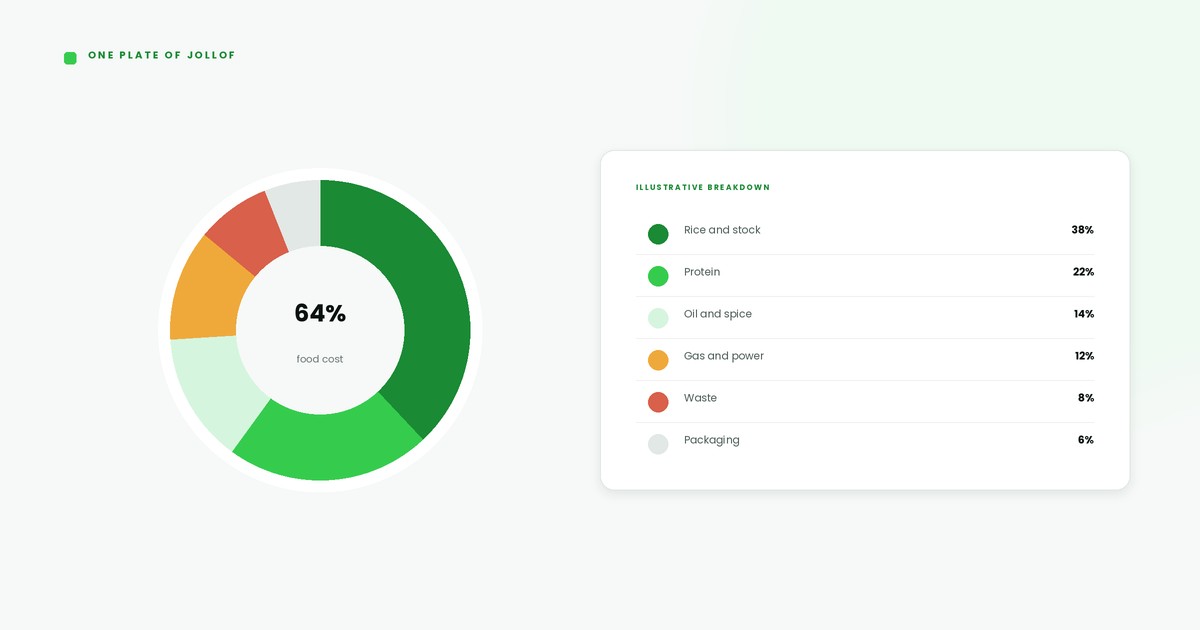
The place in Ikeja is full every lunchtime. Forty covers, sometimes fifty, and the takeaway packs go out the door in stacks.
At the end of the month the owner looks at the account and cannot explain it. Sales are up on last month. The money is not.
Nothing was stolen. The margin left through five ordinary doors, and every one of them is measurable.
Food cost percentage, and how to actually calculate it
Food cost percentage is the share of your food sales that was eaten by the food itself. The formula is not clever:
Food cost % = (opening stock + purchases - closing stock) ÷ food sales × 100
Note what it is not. It is not purchases divided by sales. If you buy three bags of rice on the 28th, purchases spike and your percentage looks terrible, even though two of those bags are still sitting in the store. You must count what is left.
Illustrative example, one month: opening stock ₦420,000, purchases ₦1,850,000, closing stock ₦510,000, food sales ₦4,200,000. Cost of food used is ₦1,760,000, which is 41.9% of sales. Those figures are illustrative, not a benchmark.
The number alone means nothing. The number next to last month's means everything. If you were at 36% and you are now at 42% on similar sales, six kobo in every naira has gone somewhere new, and there are only four places it can be: prices rose, portions grew, waste grew, or product is leaving without a sale.
A plate of jollof is a bill of materials
You cannot control a cost you have never written down. So write the plate down as a recipe, exactly the way a factory writes a bill of materials: every input, the quantity per plate, and the cost of that quantity.
The unit is the trap. You buy rice in 50kg bags and serve it in grams. You buy chicken by the kilo and serve it by the piece. Until every ingredient is converted to a per plate quantity, you are guessing.
| Input (illustrative) | Quantity per plate | Cost |
|---|---|---|
| Long grain rice | 180 g | ₦430 |
| Chicken, one leg quarter | 250 g | ₦1,250 |
| Tomato and pepper base | 120 ml | ₦380 |
| Vegetable oil | 25 ml | ₦150 |
| Onion, seasoning, spice | portion | ₦120 |
| Foil pack and carrier bag | 1 set | ₦180 |
| Total plate cost | ₦2,510 |
Every figure in that table is an illustrative example, not a market price. Build yours from your own last purchase prices.
Now the arithmetic that changes decisions. At an illustrative menu price of ₦6,500, that plate carries a 38.6% food cost and leaves ₦3,990 towards rent, salaries, diesel and profit. Raise the chicken portion from 250g to 300g and the plate cost rises to roughly ₦2,760, the food cost goes to 42.5%, and you have handed away ₦250 per plate. At 40 plates a day that is ₦10,000 a day, gone, with no argument, no theft and nobody noticing.
A restaurant does not die of one bad month. It dies of fifty grams.
The general pricing logic behind that decision sits in pricing so that you actually make money.
Why the same dish costs a different amount every day
Because it is cooked by people, and people are not scales.
Three things move the cost of a plate between Monday and Thursday. Portion drift: a tired cook at 9pm serves more generously than a fresh one at noon. Yield: a 1kg chicken does not give you 1kg of servable meat, and the gap between a 70% and a 78% yield is real money that appears on no invoice. Purchase price: the tomato price in October is not the tomato price in February.
The fixes are boring and they work. Use a ladle, a scoop or a scale for every costed ingredient, not a hand. Recost the recipe whenever a key input moves more than about 10%. Measure yield on your main protein monthly: weigh in, weigh the servable output, divide. If your recipe assumes a yield you no longer get, your plate cost is fiction.
Waste, spoilage and the bin nobody writes in
Waste is the cost that never appears anywhere. The food was bought, it was counted into the store, it never became a sale, and the loss silently inflates your food cost percentage with no explanation attached.
Keep a waste log at the pass. Four columns is enough: item, quantity, reason, staff initials. Reasons come from a short fixed list, because free text becomes useless: spoiled, over produced, dropped, sent back by customer, cooking error.
Illustrative example: two trays of unsold jollof at the end of a slow Tuesday, costed at ₦2,510 a plate equivalent, is roughly ₦45,000 of food in the bin in one evening. Nobody would tolerate ₦45,000 missing from the till. The same amount in the bin usually gets a shrug.
Over production is the biggest line in most kitchens, and it is a forecasting problem rather than a discipline problem. Your own sales history by day of week is the answer, and it is free.
Staff meals are a real cost, so record them
Staff eat. They should. Pretending it does not happen just moves the cost into your variance and makes your stock records wrong.
Set the policy, then record it. One meal per shift, from a defined staff menu, recorded as an internal issue rather than a sale. Illustrative example: six staff, one meal each, six days a week, at ₦900 of food cost a meal, is about ₦129,600 a month. That is a legitimate cost of running a kitchen, and it belongs in your books as one, not hidden inside a food cost percentage you cannot explain. It also stops staff meals from looking like stock that never matches your records.
The delivery platform commission problem
A plate sold on Chowdeck or Glovo is not the same plate sold at your counter, and treating the two as one number is how restaurants grow their revenue into a loss.
Work it per order. Take the platform's gross price, subtract the commission you actually agreed, subtract packaging, subtract any discount you funded in a promo, and only then compare what is left to your plate cost.
| Line (illustrative) | Counter | Delivery platform |
|---|---|---|
| Menu price | ₦6,500 | ₦7,200 |
| Platform commission, illustrative 20% | ₦0 | ₦1,440 |
| Packaging | ₦180 | ₦320 |
| Net received | ₦6,320 | ₦5,440 |
| Plate cost | ₦2,510 | ₦2,510 |
| Contribution | ₦3,810 | ₦2,930 |
Every figure there is illustrative, including the 20%, which stands in for whatever rate you have actually agreed rather than any published rate. Use your own contract.
The point is not that delivery is bad. It is that contribution per plate is lower, so it has to be volume that would not otherwise have walked in, and platform prices usually need setting independently of counter prices. Dishes with a high food cost percentage are the worst candidates for a platform, because commission is charged on the price, not on your margin.
When Chowdeck and Glovo orders land on the same set of records as your counter sales, that comparison stops being a monthly guess.
Frequently asked questions
How do I calculate food cost percentage for a restaurant?
Take opening stock plus purchases minus closing stock to get the cost of food actually used, then divide by food sales for the same period and multiply by 100. You must count closing stock, because purchases alone swing wildly with buying patterns and will mislead you every time.
What is a good food cost percentage in Nigeria?
There is no published Nigerian benchmark worth quoting, and your right number depends on your menu, your rent and your volume. Use your own trend instead: the direction of your percentage month on month, with a written reason for any move of more than two or three points.
Why does the same dish cost me a different amount each day?
Three reasons: portions drift when nobody weighs, protein yield varies between deliveries, and input prices move. Fixing portions with a scoop or scale, measuring yield monthly and recosting recipes when an input moves about 10% removes most of the variation.
Are delivery apps worth it for a small restaurant?
They can be, but only if you cost each order after commission, packaging and any promo you funded, and only if the volume is genuinely additional. Set platform menu prices separately from counter prices, and keep your highest food cost dishes off the platform.
Cost every plate once, then let the till do the rest
Wayg holds recipes as bills of materials, so every plate you sell moves the right quantity of rice, chicken and oil out of stock and carries a true cost with it. Point of sale, inventory and bookkeeping sit on one set of records, and Chowdeck and Glovo orders land in the same place as counter sales, so your food cost percentage is a live number rather than a month end argument.
Get started freeThe free plan needs no card.