BlogPlaybooks
Producers and distributors: true unit cost and the debtor book
One business makes the thing and does not know what it costs. The other sells it on credit and cannot say who owes what.
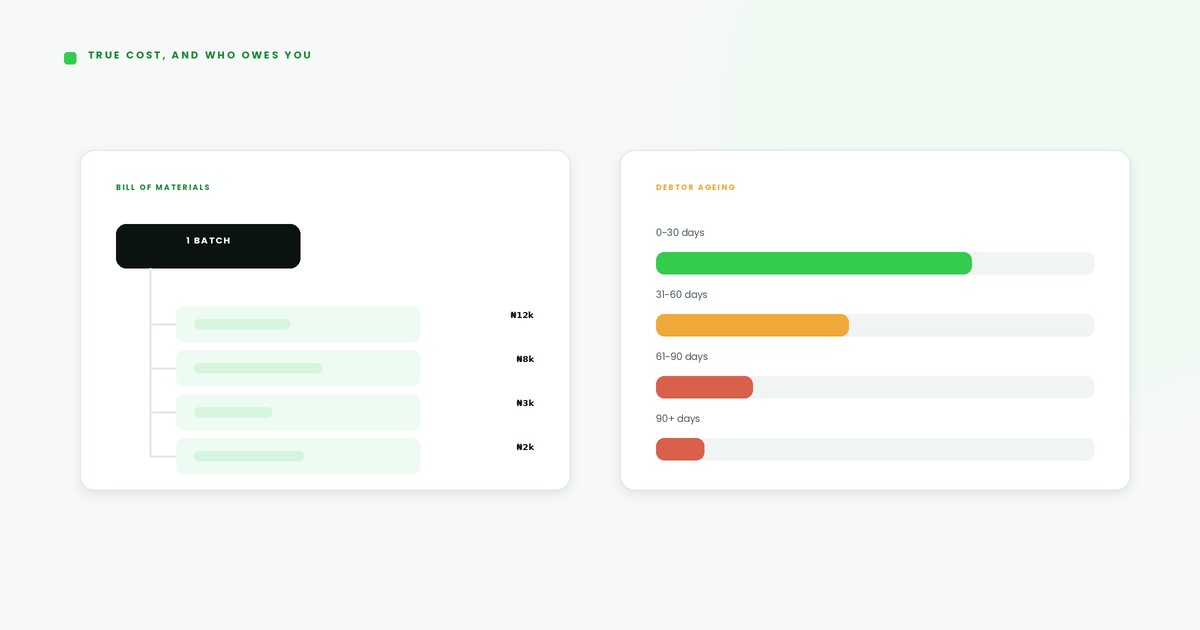
Two businesses, one problem, opposite ends of it.
The producer can tell you what the raw materials cost and nothing else, so every quote is a guess dressed as a price. The distributor can tell you the invoice total and nothing else, so half the profit is sitting in someone else's shop, ageing.
Both are solvable with arithmetic you already know. What is usually missing is the structure to hang it on.
Part one, for producers: the bill of materials
A bill of materials is the recipe for one unit, written down: every input, the exact quantity, and the cost of that quantity at your last purchase price.
Two rules make it work. Convert everything to the unit you actually consume: you buy shea butter in 25kg buckets and use it in grams, so the BOM carries grams and a cost per gram. And include packaging, because the jar, the label, the shrink band and the carton are as much a part of the product as what goes inside it.
Keep the BOM versioned. When a supplier, a quantity or a price changes materially, create a new version rather than overwriting the old one. Otherwise you lose the ability to answer the most useful question in production costing: why is this batch more expensive than the one in August?
Batch costing: what one production run really cost
Cost the batch, then divide. Costing a single unit directly is how labour and energy get lost.
| Batch of body butter, 240 jars planned (illustrative) | Cost |
|---|---|
| Shea butter, 18 kg | ₦144,000 |
| Carrier and essential oils | ₦46,000 |
| Jars, lids and labels, 240 sets | ₦96,000 |
| Cartons and tape | ₦11,000 |
| Direct labour, 3 people x 1 day | ₦30,000 |
| Diesel and power for the run | ₦12,000 |
| Factory rent and overhead absorbed for the day | ₦25,000 |
| Total batch cost | ₦364,000 |
Every figure there is an illustrative example, not a market price or a benchmark.
The arithmetic that follows is where most producers go wrong. Planned output was 240 jars, so ₦364,000 ÷ 240 gives ₦1,517 a jar. But you did not get 240 jars. You got 228 good ones, because 7 filled short, 3 jars chipped and 2 labels went on crooked and cannot ship.
Unit cost = total batch cost ÷ good units, so ₦364,000 ÷ 228 = ₦1,596.
That ₦79 difference is a 5.2% understatement of cost, and it is the difference between a margin and a rounding error. It compounds every time you quote a distributor price off the wrong figure.
Your unit cost is not what you put in. It is what you put in divided by what you can actually sell.
Yield and wastage, measured rather than assumed
Yield % = good units ÷ planned units × 100. In the batch above, 228 ÷ 240 is 95%.
Record it every run with a reason from a short fixed list: short fill, breakage, label defect, contamination, machine setup. Setup loss is the one people forget and the most predictable of all, because the first few units of a run are often unsellable. If setup loss is a flat 5 units per run, a 50 unit batch loses 10% to setup and a 500 unit batch loses 1%. That alone can decide your batch size.
Watch yield as a trend. A yield drifting from 96% to 91% over six runs is telling you something about a machine, a supplier or a new staff member, and telling you before the month end accounts do.
Why unit cost is not just materials
Four costs live outside the BOM and all four are real.
Direct labour is the hours actually spent on the run, not a share of everyone's salary. Energy is diesel, volatile enough here to deserve its own line rather than being buried in overhead. Absorbed overhead is the share of rent, supervision and equipment belonging to this batch, usually allocated by production hours, and the method matters less than applying it consistently. Fourth is rework: the batch you remade, the units you sold as seconds.
Leave all four out and your unit cost is materials cost with a different name, and you will win business you cannot afford to fulfil. The margin logic sits in pricing so that you actually make money, and the same thinking applied to a plate of food is in where a restaurant's margin actually goes.
Part two, for distributors: the debtor book is the business
If you sell to shops, you sell on credit. That is not a weakness, it is the market. The weakness is not knowing, on any given Tuesday, exactly who owes what and for how long.
Start with terms that are written rather than understood: net 14 or net 30 from invoice date, a stated credit limit per customer, and what happens when a payment is late. Terms nobody wrote down are terms your customer will interpret generously.
Then measure the one number that tells you whether the book is working:
Days sales outstanding = (debtors ÷ credit sales for the period) × days in the period.
Illustrative example: debtors of ₦8,400,000 against credit sales of ₦18,000,000 in a 30 day month gives a DSO of 14 days. If your stated terms are net 14, you are running a tight book. If your stated terms are net 14 and your DSO is 31, your terms are decorative.
Ageing buckets, and what each one means
An ageing report splits what you are owed by how long it has been owed, from the invoice date. Four buckets is enough.
| Customer (illustrative) | 0–30 days | 31–60 | 61–90 | 90+ | Total |
|---|---|---|---|---|---|
| Mama Chidi Stores | ₦480,000 | ₦0 | ₦0 | ₦0 | ₦480,000 |
| Balogun Wholesale | ₦1,250,000 | ₦640,000 | ₦0 | ₦0 | ₦1,890,000 |
| Ajayi & Sons | ₦300,000 | ₦410,000 | ₦380,000 | ₦520,000 | ₦1,610,000 |
| Northside Provisions | ₦0 | ₦0 | ₦0 | ₦295,000 | ₦295,000 |
| Total | ₦2,030,000 | ₦1,050,000 | ₦380,000 | ₦815,000 | ₦4,275,000 |
Illustrative figures throughout.
Read it by shape, not by size. Mama Chidi is current and pays on terms, so she is a candidate for a higher limit. Balogun is large and slightly slow, which is normal for volume, and the question is whether that 31–60 balance is stable or growing. Ajayi & Sons is the dangerous one: money in every bucket means each new delivery is funding the old debt, and the 90+ balance has stopped being a receivable and become a loss you have not written down yet. Northside is a single old invoice, which is usually a dispute, and disputes get resolved by a phone call rather than a reminder message.
The percentage in 90+ is your headline. Here it is 19% of the book, which is a problem for this week rather than next quarter.
How to decide who gets credit
Four tests, applied before the first credit sale and reviewed quarterly.
Payment history is the strongest predictor you have, so start every new customer on cash or part payment for three orders and watch. Concentration is second: if one name is more than a quarter of your debtors, you are that customer's supplier and their partner at the same time. Third, size the limit to sales velocity rather than ambition, because a shop that sells ₦400,000 of your goods a month does not need a ₦2,000,000 limit, and giving them one produces returns and dead stock rather than sales. Fourth, set a hard stop: supply pauses automatically at a stated overdue age, enforced by the system rather than negotiated at the gate by a driver who wants to finish his route.
Both halves of this post are the same problem in different clothes. Stock sitting in your warehouse and goods sitting unpaid in a customer's shop are both capital you have spent that has not come back. Dead stock and what to do about it is the stock side of it, and the daily habit that keeps a credit book honest is in the daily numbers that matter.
Frequently asked questions
How do I calculate true unit cost for a production batch?
Total every cost of the run, including materials, packaging, direct labour, energy and an allocated share of overhead, then divide by the good units you can actually sell rather than the units you planned. Dividing by planned output understates cost by exactly your wastage rate.
What is a bill of materials and do I need one?
It is the costed recipe for one unit, listing every input at the quantity you actually consume, including packaging. You need one the moment you quote a price, otherwise you are pricing off materials you remember rather than materials you used.
What are debtor ageing buckets?
They split what customers owe you by how long each invoice has been outstanding, usually 0–30, 31–60, 61–90 and 90 plus days. The shape matters more than the total: balances in every bucket mean new deliveries are funding old debt.
How do I decide how much credit to give a customer?
Start new customers on cash for their first few orders, set the limit against monthly sales velocity rather than their request, cap how much of your book any one customer holds, and enforce an automatic supply pause at a stated overdue age.
Cost the batch, then watch the book
Wayg holds materials and bills of materials alongside stock, so a production run consumes the right inputs and gives you a unit cost you can price from, and customer balances sit on the same set of records as the sales that created them. Daily reconciliation and variance detection catch the gap between what a batch should have yielded and what it did, and the Wayg Assistant will tell you who is in 90 plus if you ask.
Get started freeThe free plan needs no card.