BlogBooks
Why a profitable shop still runs out of cash
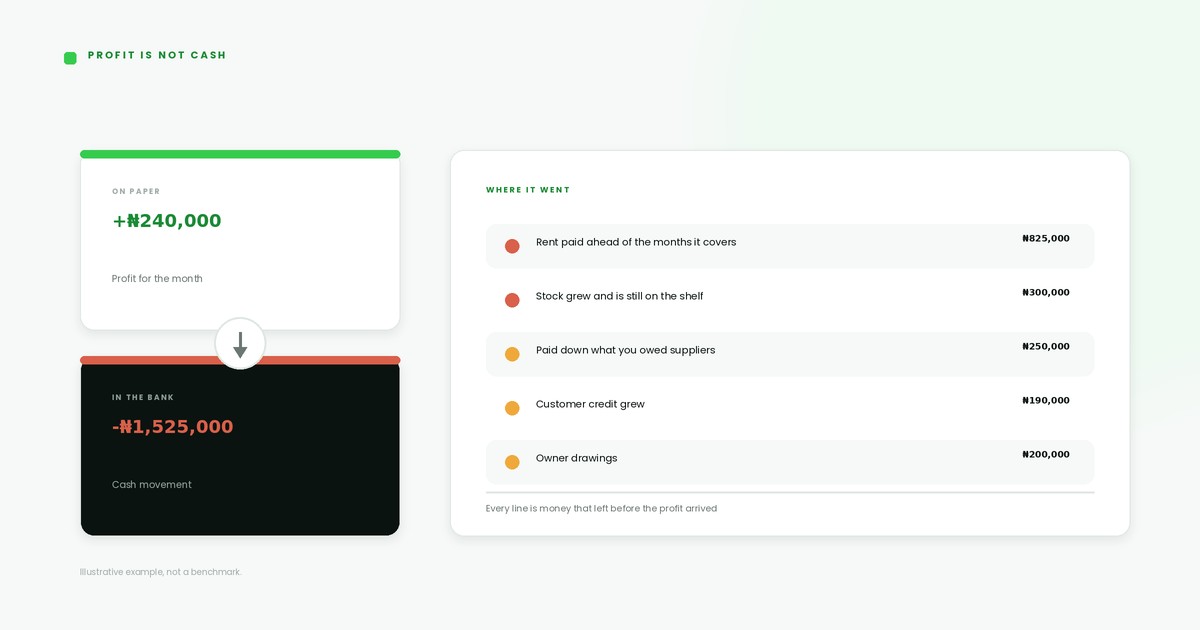
Your profit and loss says ₦240,000. Your bank says you are ₦125,000 short. Both are right, and the difference has five names.
You closed the month and the arithmetic was good. Sales were up, margin held, and the summary at the bottom said the shop made money.
Then the landlord's agent called, and you looked at the bank, and there was nothing there.
This is the most common and most demoralising experience in small business, and almost nobody explains it properly. You are not bad at maths and your books are probably not wrong. Profit and cash are two different measurements of two different things, and a shop can have plenty of one and none of the other for months.
Profit is a story about timing. Cash is a fact about today
Profit says: over this month, the value of what you sold exceeded the cost of what you sold it for. It counts a sale the day the goods leave, whether or not the customer has paid you. It counts stock as a cost only when it sells, not when you buy it. It spreads a year of rent across twelve months, because that is the period the rent actually covers.
Cash says something much narrower: money came in, money went out, here is what is left.
Every one of those timing differences is a place where a profitable month can drain your bank account. Five of them do almost all the damage.
The month that looked good and felt terrible
Illustrative example, not a benchmark. A provisions shop's month on paper:
| Profit and loss | Amount |
|---|---|
| Sales | ₦4,200,000 |
| Cost of goods sold | ₦3,400,000 |
| Gross profit | ₦800,000 |
| Rent charge, salaries, diesel, transport | ₦560,000 |
| Profit for the month | ₦240,000 |
Now the same month in the bank. The shop started with ₦1,400,000 in cash and bank between them.
| Cash movement | Amount |
|---|---|
| Collected from customers (sales less ₦310,000 new credit given, plus ₦120,000 of last month's credit collected) | ₦4,010,000 |
| Paid to suppliers (₦3,700,000 of stock bought this month, plus ₦250,000 still owed from last month) | (₦3,950,000) |
| Operating costs paid, excluding rent | (₦485,000) |
| A full year of rent, paid in one go | (₦900,000) |
| Taken by the owner for personal use | (₦200,000) |
| Net cash movement | (₦1,525,000) |
| Closing position | (₦125,000) short |
Profit of ₦240,000. A bank account ₦125,000 in the hole, covered by begging a supplier for another week. Nothing in either table is wrong.
The bridge from one number to the other
Here is the same month as a single walk. This is the most useful page of arithmetic a shop owner can learn to do.
| From profit to cash | Effect |
|---|---|
| Profit for the month | ₦240,000 |
| Stock grew: bought ₦3,700,000, sold ₦3,400,000 | (₦300,000) |
| Customer credit grew: gave ₦310,000, collected ₦120,000 | (₦190,000) |
| Paid down what you owed suppliers | (₦250,000) |
| Rent paid ahead of the months it covers | (₦825,000) |
| Owner drawings | (₦200,000) |
| Cash movement | (₦1,525,000) |
Read the five middle lines again, because that is the whole article. Stock you bought and have not sold. Goods you handed over and have not been paid for. Money you owed and have now paid. Costs paid far ahead of the period they belong to. Money you took out that never got written down anywhere.
Profit tells you the business works. Cash tells you whether it survives long enough to prove it.
The cash cycle, without the jargon
There is a standard way to measure how long your money is locked up. Strip the accounting language off it and it is three plain questions.
How many days does stock sit before it sells? Take the value of stock on your shelves, divide by your cost of goods sold for the month, multiply by 30.
How many days do customers take to pay you? Take the value of the debtor book, divide by sales for the month, multiply by 30.
How many days do you get before you must pay suppliers? Take what you owe suppliers, divide by purchases for the month, multiply by 30.
Then: days stock sits, plus days customers take, minus days suppliers give you, equals the number of days your own money is standing in for the business.
Illustrative example for the same shop: stock sits 30 days, customers take 11 days, suppliers give you 12 days. That is 30 + 11 − 12 = 29 days. Every naira of growth needs roughly a month of funding before it comes back. Grow sales 20% and you do not need 20% more effort, you need roughly a month's worth of that extra 20% in cash, up front, before any of it returns.
That is why growing shops go broke. Growth consumes cash first and repays it later.
The four levers that shorten it
You cannot change the cycle by working harder. You change it in four places, and only four.
1. Make stock move faster. Every slow line is a bag of cash sitting on a shelf pretending to be an asset. Cut the number of weeks of cover you hold on slow movers and put the freed money into fast ones. Dead stock: how to spot it and what to do about it is the practical version of this.
2. Collect faster. Set a limit per customer, an age limit on the debt, and a rule you actually enforce: no new credit while the old credit is open. Ring on the day it is due, not two weeks after.
3. Get real terms from suppliers instead of defaulting to cash. Fourteen days on a ₦3,700,000 monthly purchase run is roughly ₦1,700,000 of financing you did not have to find. Terms are negotiable far more often than price, which is the point of how to buy better.
4. Buy smaller and more often. Ordering fortnightly instead of monthly halves the cash tied up in an average delivery, even though the annual quantity is identical.
The lumpy costs nobody budgets for
The five drains above are structural. The thing that actually triggers the crisis is usually something else: a big, irregular payment that arrives on a date nobody wrote in a diary.
A year of rent. A generator rewind. The Christmas or Sallah bulk buy. A shelving refit. A vehicle repair. Each one is normal. All of them together, landing in a month when stock also happened to be high, are a closed shop.
Treat them as a monthly cost even though you pay them yearly. Illustrative example: ₦900,000 of annual rent is ₦75,000 a month; put that ₦75,000 somewhere you will not spend it, and rent day stops being an event. Do the same for the two or three other lumpy items you know are coming. A shop that sets aside ₦150,000 a month this way is ₦1,800,000 calmer by year end.
And write down your drawings. Money taken out of the tin for school fees is not theft and it is not a mystery, but if it is never recorded it turns into an unexplained gap that you will later blame on your staff. The monthly close is where that gets caught.
Frequently asked questions
Why is my business profitable but has no money in the bank?
Almost always because cash left for things profit does not count yet: stock bought and still sitting, credit extended to customers, supplier balances paid down, costs paid ahead of the period they cover, and owner drawings. Build the bridge from profit to cash for one month and the gap will name itself.
What is a cash conversion cycle in simple terms?
It is the number of days between paying for goods and getting the money back from the customer who buys them. Days stock sits, plus days customers take to pay, minus days your suppliers give you. The bigger that number, the more of your own cash the business needs just to stand still.
Does growing sales fix a cash problem?
Usually it makes it worse before it makes it better, because growth means buying more stock and often granting more credit before any of the extra money comes back. Fix the cycle first, then grow into it.
How much cash should a small shop keep in reserve?
There is no reliable published figure to point you at, so work from your own numbers: total your fixed monthly costs and aim to hold enough to cover several months of them, plus a set-aside for the lumpy annual items you already know are coming.
See profit and cash side by side, on the same records
Wayg keeps point of sale, inventory, store management and bookkeeping on one set of records, so what you sold, what you bought, what is still owed to you and what is left in the tin are all the same data rather than four separate stories. Daily reconciliation and variance detection catch the gap while it is still small, and you can ask the Wayg Assistant what changed, in plain words.
Get started freeThe free plan needs no card.