BlogBooks
How to buy better: suppliers, terms and purchase records
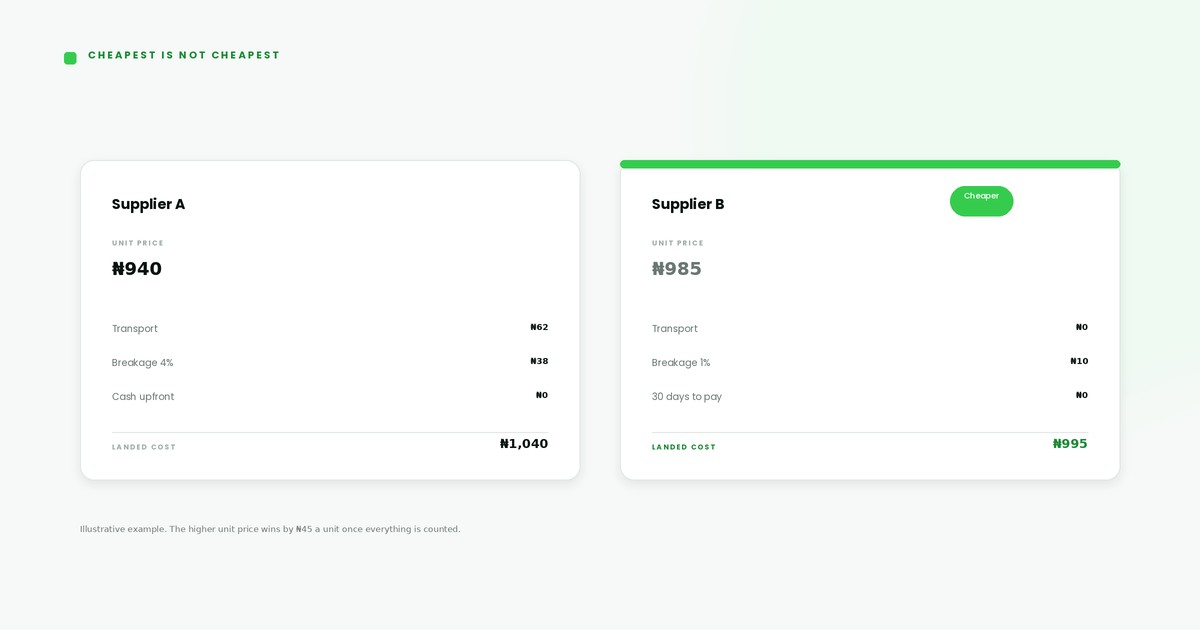
The supplier who quotes ₦4,200 can easily cost you more than the one who quotes ₦4,350. Here is the arithmetic that shows it.
The Balogun trip starts at six in the morning and the whole thing turns on one question: who is cheapest today.
So you ask three people, you take the lowest number, you pay, you load, you come home. By the time the cartons are on the shelf, nobody remembers what the other two quoted, what the transport cost, or that four of the cartons arrived crushed.
That is not buying. That is shopping. Buying is a process that leaves a record behind, and the difference between the two is usually worth more than any discount you will ever negotiate.
The cheapest unit price is rarely the cheapest landed cost
The number on the invoice is not what the goods cost you. What they cost you is everything you spent to get them saleable on your shelf, divided by the units you can actually sell.
Landed unit cost = (invoice total + transport + loading and offloading + market charges and tolls + anything you paid to get the money there) ÷ units received in sellable condition
Two words in that formula do most of the damage: sellable condition. Cartons that arrived crushed, sachets that burst, a bag short on a count nobody checked at the van. Those units are paid for and not sellable, and they quietly raise the cost of every unit that is.
Illustrative example, not a benchmark. Same product, two suppliers:
| Supplier A | Supplier B | |
|---|---|---|
| Quoted price per carton | ₦4,200 | ₦4,350 |
| Minimum order | 50 cartons | 20 cartons |
| Invoice total | ₦210,000 | ₦87,000 |
| Transport and offloading | ₦12,000 (you arrange) | ₦0 (delivers) |
| Cartons arriving damaged | 2 | 0 |
| Sellable cartons | 48 | 20 |
| Landed cost per sellable carton | ₦4,625 | ₦4,350 |
| Payment terms | Cash on collection | 14 days |
| Cash tied up on day one | ₦222,000 | ₦0 |
Supplier A looked ₦150 a carton cheaper and is actually ₦275 a carton more expensive, before you even account for the fact that A takes ₦222,000 out of your bank immediately and B takes nothing for two weeks.
Run that formula once on your three biggest lines. It is an afternoon's work and it very often changes who you buy from.
Negotiate the terms, not just the number
Most small buyers negotiate one variable, price, and they negotiate it badly because price is the thing the supplier has thought hardest about defending.
There are five other things on the table, and suppliers give them away far more readily.
Payment terms. Fourteen days on a ₦3,700,000 monthly purchase run is roughly ₦1,700,000 of financing that you did not have to find from anywhere. This is usually the single most valuable thing you can win, and it costs the supplier nothing but patience.
Delivery. Getting goods delivered rather than collected removes transport, removes your morning, and moves the risk of damage in transit onto them.
Order size. A smaller minimum, ordered more often, at the same price. Same annual volume for the supplier, far less cash frozen for you.
Returns on damage and short supply. Agree before the first order what happens when a carton arrives crushed. Agreed in advance it is a policy. Raised afterwards it is a quarrel.
Price stability. A quoted price held for a defined period is worth real money in a market where costs move. Ask for a month. You will sometimes get it.
The supplier will fight you for ₦100 a carton and hand you fourteen days without blinking. Ask for the thing they are not defending.
Record what you were quoted, not just what you paid
Almost every shop records payments. Almost none record quotes, and the quote is where the intelligence lives.
Keep a line for every price you are told, whether or not you buy: date, supplier, item, quoted price, quantity it applies to, terms offered, and whether you bought. Three months of that gives you things you cannot get any other way.
You can see which supplier's prices drift upward between visits and which hold. You can see whether the "special price" you get is actually special. You can walk into a negotiation with "you quoted ₦4,100 in July and ₦4,600 now, and the market has not moved that much", which is a completely different conversation from "ah, it has gone up again".
It also catches the quiet one: a supplier whose headline price stays flat while the quantity in the carton shrinks. Record the pack size in the same line and that becomes visible immediately instead of never.
Comparing two suppliers properly means comparing over time
One good delivery tells you nothing. A supplier is a performance record, and five things belong in it.
| Measure | How to compute it | Why it matters |
|---|---|---|
| Landed cost per sellable unit | Full formula above, per delivery | The only price that is real |
| Fill rate | Units delivered ÷ units ordered × 100 | A cheap supplier who short-supplies costs you sales you never see |
| On-time rate | Deliveries on the agreed day ÷ total deliveries | Late deliveries force emergency buying at emergency prices |
| Damage and short rate | Unsellable or missing units ÷ units invoiced × 100 | This is already inside landed cost; track it separately so you can argue about it |
| Terms honoured | Did the agreed credit period hold | A supplier who withdraws terms without notice is a cash flow event |
Illustrative example over six deliveries: Supplier A averages ₦4,510 landed, 94% fill, 67% on time. Supplier B averages ₦4,380 landed, 100% fill, 100% on time. The 6% of units A never delivered are the ones you ran out of on a Saturday, which is a cost that appears nowhere on any invoice. Keeping a reorder discipline, as in reorder points without the maths degree, is what makes a supplier's unreliability visible instead of absorbed.
What a minimum order really costs you
A minimum order quantity is presented as a condition of sale. Treat it as a price, because that is what it is.
Illustrative example: a supplier offers ₦4,200 a carton at a 50-carton minimum, against ₦4,350 at 20. You sell 10 cartons a week.
At 50 cartons you are holding five weeks of cover. The saving is 50 × ₦150 = ₦7,500. The cost is that ₦210,000 sits on your shelf for five weeks instead of ₦87,000 sitting there for two, and about ₦126,000 of the difference is money you cannot use for anything else until the stock sells.
Now ask the question that matters: is ₦7,500 the best return you can get on ₦126,000 tied up for a month? If that money would otherwise have bought a fast-moving line you turn over three times, no, it is not. And if the product is even slightly seasonal, the 50-carton buy is how a bargain becomes dead stock.
The rule of thumb worth adopting: never let a bulk discount push you past the cover you would have chosen anyway. Buy the quantity the shelf justifies, then negotiate the price.
The purchase record every delivery should leave behind
This is the part that makes all the above possible, and it takes about ninety seconds per delivery.
| Field | Example entry |
|---|---|
| Date received and who received it | 24 Sep, checked in by the supervisor |
| Supplier name | Named, consistently spelled, every time |
| Document reference | Waybill or invoice number |
| Item, pack size, quantity ordered | Detergent, 24 × 500g, 20 cartons |
| Quantity actually received | 20 |
| Quantity damaged or rejected | 1, noted on the waybill before the van left |
| Unit price on the invoice | ₦4,350 |
| Transport and other costs on this delivery | ₦0 |
| Payment terms and due date | 14 days, due 8 Oct |
| Amount paid and date, or balance outstanding | Unpaid, ₦87,000 outstanding |
Three disciplines make it work. Count at the van, not after it leaves, because a shortage found later is a shortage you own. Note damage on the waybill in front of the driver. And record the delivery on the day, because a purchase entered a week later is entered from memory, which is where phantom stock is born.
Do this consistently and two things stop happening. You stop paying an invoice twice, which is more common than anyone admits. And your cost of goods sold becomes a real number rather than an estimate, which is the only way to know your margin, and the reason pricing so that you actually make money starts to work.
The purchase record is also the other half of your cash picture. What you owe suppliers and when is half of the reason a profitable shop can still run out of cash.
Frequently asked questions
How do I calculate landed cost for a small shop?
Add the invoice total, transport, loading and offloading, market charges and any cost of getting payment there, then divide by the number of units that arrived in sellable condition. Damaged and short-supplied units stay in the numerator and leave the denominator, which is exactly the point.
Should I always buy from the cheapest supplier?
Only if cheapest means cheapest landed cost per sellable unit, delivered on time and in full, on terms you can live with. A lower quoted price with cash payment, self-arranged transport and a 4% damage rate is routinely more expensive than a higher quote delivered on 14 days.
How do I negotiate better terms with a supplier?
Go in asking for something other than price: payment days, delivery included, a lower minimum order, an agreed policy on damage, or a price held for a month. Bring your own record of past orders and volumes, because a buyer who can quote their purchase history is treated differently from one who cannot.
What should I record for every delivery?
Date, receiver, supplier, document reference, item and pack size, quantity ordered, quantity received, quantity damaged, unit price, delivery costs, payment terms with a due date, and what is still outstanding. Counted at the van, entered the same day.
Put your purchases and your shelves on the same record
Wayg keeps point of sale, inventory, store management and bookkeeping on one set of records, so a delivery received updates stock, cost and what you owe in one action rather than three. Daily reconciliation and variance detection flag the delivery that was invoiced for 20 and counted as 19, on the day it happens.
Get started freeThe free plan needs no card.