BlogComparisons
Wayg vs a spreadsheet for running a shop
Spreadsheets are free, flexible and everyone knows them. Here is exactly where they hold up in a shop and where they quietly stop working.
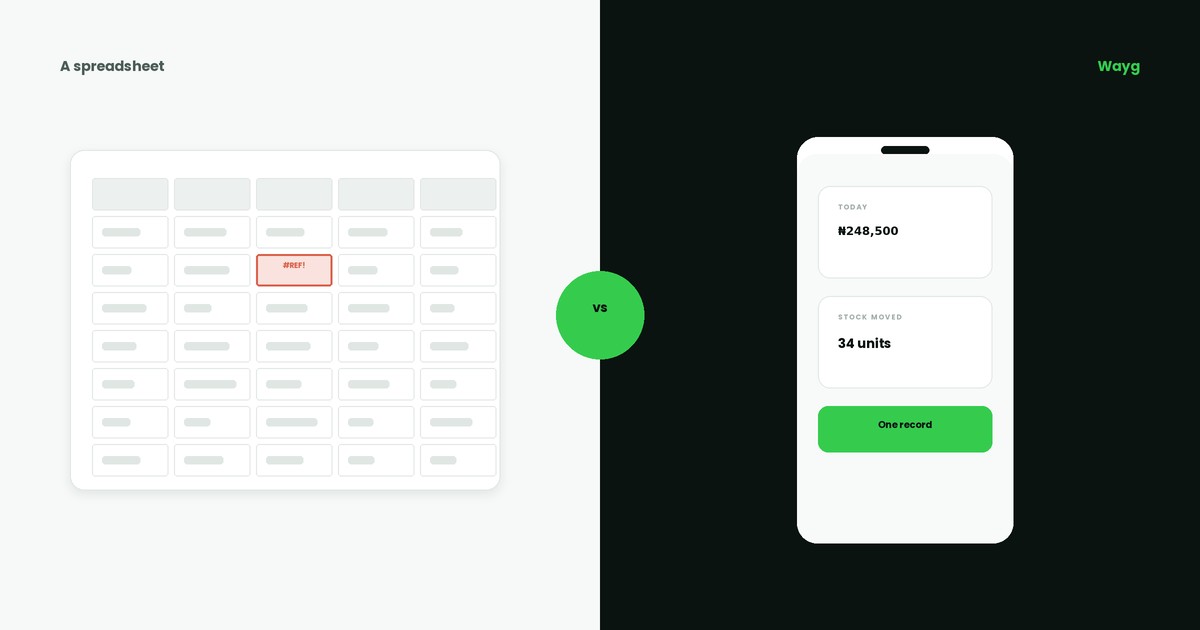
Open the folder on almost any Nigerian shop owner's laptop and you will find it: STOCK 2026.xlsx, next to STOCK 2026 FINAL.xlsx, next to STOCK 2026 FINAL (2).xlsx.
None of this is a joke about small business. That spreadsheet is doing real work. Somebody built it, somebody maintains it, and it has probably survived three staff changes and two shop moves.
The question is not whether spreadsheets are good. They are. The question is what happens to yours as the shop gets busier.
What a spreadsheet genuinely does better
Start with the honest list, because it is longer than software companies like to admit.
A spreadsheet costs nothing. If you already have a laptop and a free Google account, your stock system has a running cost of zero naira a month, forever.
It bends to any shape. You sell yards of fabric, sachets, plates of food and a service contract, all from the same counter? Fine. You need a column called "Mama Chidi owes" with a note in it? Fine. No software will ever match that.
And everybody already knows it. You do not train a new person on a spreadsheet. They open it and start typing. That is a real advantage, and it is why spreadsheets outlast most of the apps that try to replace them.
Where it starts to cost you
The failures are not dramatic. Nothing crashes. The sheet just slowly stops being true.
Two people, one file. The moment your counter person and you both need to touch stock, you have a problem. In Excel on a laptop, one of you is working on a copy, and the copy is the one that gets saved last. In Google Sheets, you get live editing, which genuinely fixes most of this, until light goes and the network drops and someone's phone syncs an hour-old version over yours. Every shop that runs on shared sheets has a story about a day of sales that vanished.
Recording a sale does not move your stock. This is the big one. In a spreadsheet, the sale goes in the sales tab and the stock count sits in the stock tab, and the link between them is a formula somebody has to keep alive. So most owners do it the other way: they record sales all day and reconcile stock weekly or monthly, by counting. Which means for six days out of seven you do not know what you actually have. If you have ever promised a customer something you had already sold, that is the gap.
Formulas break quietly. Someone inserts a row and a SUM range stops one row short. Someone types 12,500 with a comma and the cell becomes text, so it adds as zero. Someone drags a fill handle and a lookup shifts by one. Nothing turns red. Your total is simply wrong, and it stays wrong until a number is so strange you go looking.
It does not work at a counter. A phone showing a spreadsheet is a phone showing tiny cells. You can do it. Nobody does it twice while a customer is waiting and two more are behind him.
There is no audit trail. A spreadsheet cannot tell you who changed the price of a carton of noodles on Tuesday, or who deleted four rows. Google Sheets version history helps and is better than nothing, but it shows you file states, not business events. "Who voided this sale and why" is not a question a sheet can answer.
And then the person who built it leaves. This is the one that ends spreadsheets. The sheet made sense to one person: the nested formula, the hidden column F, the tab called do not touch. When that person goes, you inherit a machine nobody can service. Most shops respond by rebuilding from scratch and losing their history.
A spreadsheet records what you tell it. It cannot notice what you forgot to tell it.
The comparison, line by line
| Spreadsheet | Wayg | |
|---|---|---|
| Cost | Free, or the cost of Office | Free plan at ₦0; paid plans from ₦5,000/month |
| Flexibility | Total. Any column you want | Structured around products, stock, sales and books |
| Learning curve | Everyone already knows it | New interface to learn, plus voice and text input |
| Multi-user editing | Live in Sheets; conflict-prone in Excel | Multiple users by plan, with roles and permissions |
| Stock moves when a sale is recorded | Only if you built and maintain the link | Yes, one set of records |
| Formula breakage | A permanent risk | No formulas to break |
| Usable on a phone at the counter | Poor | Web, iOS and Android |
| Audit trail | File version history at best | Audit trails on user actions |
| Variance detection | You spot it yourself, later | Daily reconciliation with variance detection |
| Works offline | Yes, in Excel | Needs a connection |
| If the builder leaves | You inherit a machine nobody can service | The records stay in a standard shape |
| Payroll, lending, tax filing to the revenue service | No | No, and Wayg does not claim to |
Two rows there deserve emphasis. Offline is a genuine spreadsheet win, and in a shop where light and network both go, it matters. And the last row is not a joke: Wayg is not a bank, not a payroll system and does not file your returns for you. It keeps the records those things need.
When a spreadsheet is still the right call
Say this plainly, because it is true for a lot of readers.
If you are one person selling twenty product lines, you close the shop yourself, you count stock every Saturday and the count usually balances, a spreadsheet is fine. Adding software would add work, not remove it.
If your business is project-shaped rather than stock-shaped, a consultancy, a builder, a photographer with three jobs a month, a sheet plus a folder of invoices is genuinely proportionate.
And if you are modelling something, pricing scenarios, a batch cost, a "what if diesel goes up" calculation, use a spreadsheet. It is the better tool for thinking. It is a worse tool for recording.
The switch tends to make sense at a specific point: when a second person starts touching stock, or when the number of lines passes the point where you can hold the shop in your head. Around that point the weekly reconciliation stops being ten minutes and starts being an evening.
Moving without losing what you built
You do not throw the sheet away. Wayg imports from spreadsheets, and it also imports from handwritten notes, so the products, prices and opening stock you already typed become the starting balance rather than a re-typing job.
The practical order that works: export or tidy one product list with name, price, cost and current quantity; import it; run one full stock count on day one so the opening numbers are real; then run both systems for a week and compare. If you want the counting method, how to run a stock count that balances covers it.
Keep the sheet. It costs nothing to keep, and for the first month it is your check on the new numbers.
Frequently asked questions
Can I still use Excel alongside Wayg?
Yes, and many people do, especially for pricing models and one-off analysis. The difference is that the shop's live record of sales, stock and cash sits in one place, and the spreadsheet becomes a thinking tool rather than the system of record.
Is a spreadsheet inventory alternative worth paying for if I only have one shop?
It depends on whether anyone else touches your stock. One person, one shop, a manageable product list: stay on the sheet. Two or more people recording sales and receiving goods: the reconciliation cost usually passes the subscription cost quickly.
What happens to my old spreadsheet data?
Import it. Wayg lists spreadsheets among the sources it imports from, so your product list, prices and opening quantities carry over instead of being retyped. Your historical sheets stay yours regardless.
Why does my spreadsheet stock never match the shelf?
Usually because sales and stock are updated in two separate places at two separate times. The gap between them is where breakage, samples, staff purchases and simple mistyping live. Why your stock never matches your records walks through the six usual causes.
This is general information, not tax advice. Confirm any figure, deadline or treatment with a tax adviser or the revenue service.
Try it against the sheet you already have
The fair test is not a demo. Import your own product list, run a week of real sales through both, and see which set of numbers you trust on Saturday evening. If the spreadsheet wins, you have lost a week and learned something useful. Wayg's free plan covers one user, 50 products and 60 AI credits, which is enough to run that test properly.
Get started freeThe free plan needs no card.