BlogPlaybooks
When the numbers say open a second shop
The first shop is a job you are good at. The second one is a system, and most people find that out after signing the lease.
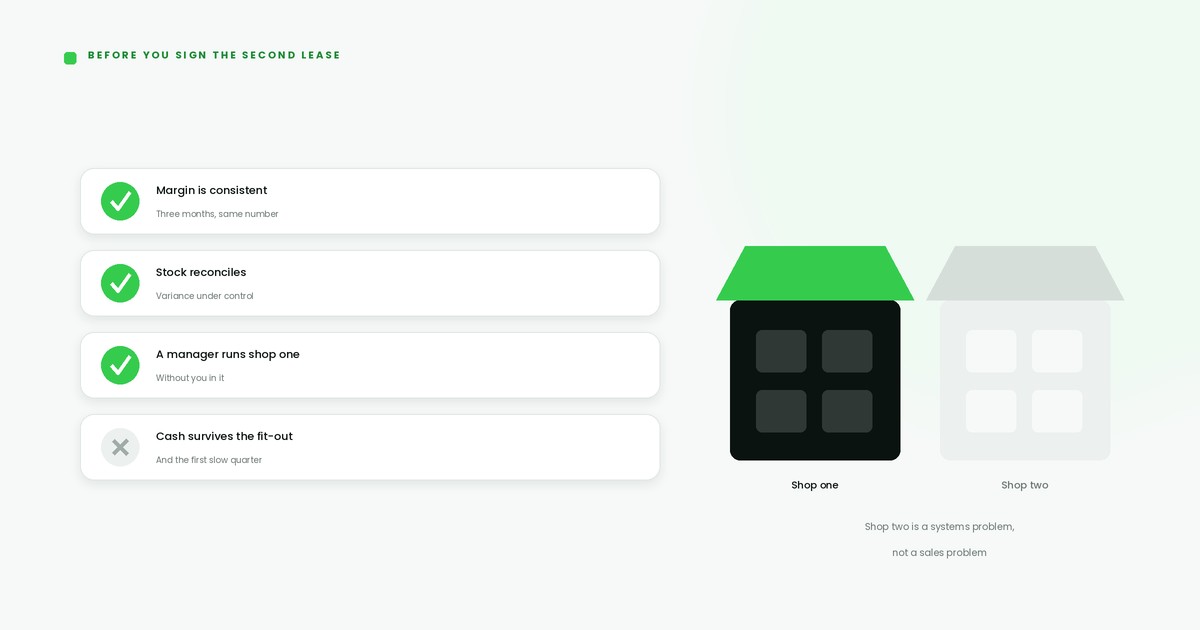
The unit two streets over has come free and the rent is reasonable. Your shop is busy. Customers from that side already come to you. It feels obvious.
Here is the uncomfortable pattern: the second shop rarely fails because the location was wrong or because nobody bought anything. It fails because it doubled the number of places where stock, cash and records can disagree, while the person who used to hold all of that in his head was now only in one of the two buildings at a time.
A second shop is not more selling. It is the first time your business has to run on records instead of on you.
Four numbers that should be true before you sign anything
Not opinions. Numbers, measured over at least six months of the shop you already have.
| What to check | The test | Why it has to be true first |
|---|---|---|
| Margin is consistent | Gross margin within about 2 percentage points, month to month, for six months | An unstable margin means you do not yet know what drives it. A second shop will not clarify it, it will average it into fog |
| Stock reconciles | Count variance on your top lines under roughly 1% of sales, repeatably | Whatever your shrink rate is now, expect it to be worse in a shop you do not stand in |
| Somebody else can run shop one | A manager ran it for four consecutive weeks without you on site, and the numbers held | If you have never tested this, you are not opening a second shop, you are leaving your first one unattended |
| Cash survives the fit-out and then some | Full fit-out cost, plus six months of the new shop's fixed costs, in hand and untouched | Shop two will not pay for itself in month one, and shop one must not be raided to keep it alive |
The fourth one is where most people negotiate with themselves. Do not. The shop that closes in month seven is almost never the one that failed to sell. It is the one that ran out of cash while it was still ramping, and that dragged the profitable shop down with it.
That mechanism is the ordinary profit-versus-cash gap, at double size and against a clock: stock bought and sitting, costs paid ahead, nothing coming back for months. Why a profitable shop still runs out of cash is the arithmetic.
The costs people forget
Illustrative example, not a benchmark. Ask most owners what a second shop costs and you will hear the first two lines of this table.
| Line | Illustrative cost |
|---|---|
| Rent, paid two years up front | ₦1,800,000 |
| Shelving, counter and fit-out | ₦450,000 |
| Opening stock | ₦2,400,000 |
| Point of sale hardware and connectivity | ₦180,000 |
| Signage, paint and the first month's push | ₦150,000 |
| Agency, legal and deposit | ₦270,000 |
| Generator and installation | ₦350,000 |
| Staff for three months before it breaks even (3 × ₦180,000) | ₦540,000 |
| Opening float | ₦100,000 |
| Total before the first customer pays for itself | ₦6,240,000 |
The two lines people budget for come to ₦2,250,000. The real figure in this example is nearly three times that, and the two biggest surprises are the ones with no receipt attached: opening stock, which is cash converted into shelves, and the wage bill for the months before the shop covers itself.
There is a third cost with no line in any table. Your own attention. For the first three months you are effectively running one business badly and one business barely, and shop one's numbers will show it if you are measuring honestly.
The second shop does not test whether you can sell. It tests whether your first shop was a system or a personality.
A second shop is a systems problem, not a sales problem
Everything that worked informally in one location breaks at two, and it breaks in the same order every time.
Pricing. One shelf price becomes two, and they drift. Someone marks up a line in the new shop to cover the higher rent, a customer notices, and now you are explaining yourself. Decide deliberately: one price list, or two with a written reason.
Cash. Two tins, two sets of transfer alerts, often two accounts. The single most common multi-shop failure is cash that gets moved between locations to cover a supplier and never recorded as a movement, so both shops' reconciliations are wrong in opposite directions.
Buying. Two shops buying separately lose the volume you just earned. Two shops buying centrally need a way to split the delivery and the cost accurately, which is a record-keeping problem, not a logistics one. Get your purchase records right in one shop before you need them in two.
Authority. The manager at shop two will need to give a discount, take a refund and write off a damaged carton without calling you at 8pm. That means permissions with limits and an audit trail, decided before opening day rather than improvised in week three. Who should see what is the whole of that argument.
If any of those four are currently held together by you personally answering a phone, fix it in shop one first. It is much cheaper to discover the gap in a shop that is already profitable.
Transfers between shops are a brand new way to lose stock
This is the one nobody anticipates, and it is worth its own section.
The moment you have two locations, stock starts moving between them, usually informally: shop two runs out of a fast line on a Saturday, someone carries six cartons across in a keke, and it gets sorted out later. Later never arrives.
A transfer is two entries, not one. Stock out of A and stock into B. Get one without the other and the arithmetic is brutal: A shows a shortage, B shows a surplus, your total is right, and every reconciliation you run tells you a lie in two directions at once. This is the same mechanism described in why your stock never matches your records, doubled.
Three rules, adopted on day one, prevent almost all of it.
No transfer without a document. A transfer note with item, quantity, date, who released it and who received it. The receiving shop counts and signs, the same way you would treat a supplier's van.
A transfer in flight is somebody's stock. Decide whose. The simplest rule is that it stays on the sending shop's records until the receiving shop confirms it, so an unconfirmed transfer shows up as an open item rather than vanishing.
Both sides reconcile it the same day. A transfer that is a day old is a conversation. A transfer that is three weeks old is a write-off.
Illustrative example of the cost: six cartons at ₦4,350 landed is ₦26,100. Do that twice a month, unrecorded, and you have built a ₦626,400 annual hole out of pure helpfulness.
What to measure in the first ninety days
Do not judge a new shop on profit in month one. Judge it on whether it is behaving like a business that will get there.
| By | What you check | What good looks like |
|---|---|---|
| Day 30 | Daily cash and transfer variance, both shops, separately | Small variances in both directions, none clustered on one shift |
| Day 30 | Stock count on the top 20 lines by value at shop two | Variance under roughly 1% of shop two's sales |
| Day 45 | Gross margin at shop two against shop one | Within about 2 points, or a written explanation of why not |
| Day 60 | Transfers log | Every transfer confirmed by both sides, none open more than a day |
| Day 60 | Shop one's margin and variance | Unchanged from before you opened. If it slipped, shop two is eating shop one |
| Day 90 | Contribution: shop two's gross profit against its own fixed costs | Covering its own rent, wages and diesel, even if not yet the fit-out |
| Day 90 | Cash reserve remaining | Enough left for three more months of shop two's fixed costs |
The two rows that decide it are day 60's shop one check and day 90's cash reserve. If shop one is deteriorating, you have a management problem, not a location problem, and adding a third shop will not fix it. If the reserve is nearly gone at day 90, stop spending on the new shop and do nothing else until the position is stable.
The daily discipline behind all of it is the same one that runs a single shop well, just performed twice. The daily numbers that matter is the routine, and it should be running in both locations from opening day, not introduced once the second shop starts misbehaving.
Frequently asked questions
When is the right time to open a second shop?
When the first one has produced a stable gross margin for six months, its stock reconciles on a count, someone other than you has run it for a month without the numbers slipping, and you hold the full fit-out cost plus six months of the new shop's fixed costs in cash. Sales being good is not one of the four.
How much cash do I need to open a second location?
More than the rent and shelving, which is where most budgets stop. Add opening stock, hardware, signage, agency and deposit, a generator if you need one, and several months of wages before the shop covers itself. In the illustrative example above, the two obvious lines were about a third of the real total.
How do I manage stock across two shops?
Treat every movement between shops as a two-sided transaction with a document: released by someone, received and counted by someone, confirmed the same day. Unconfirmed transfers should sit visible as open items rather than silently disappearing from one shop's records.
What should a manager be allowed to do at a second branch?
Enough to run a day without calling you: sell, receive deliveries, approve discounts and refunds up to a set naira ceiling, and correct stock with the correction logged against their name. Not user administration, and not unlimited price overrides or write-offs.
Run two shops on one set of records
Wayg keeps point of sale, inventory, store management and bookkeeping on one set of records, so a second location is another set of numbers in the same system rather than a second business to reconcile against the first. Daily reconciliation and variance detection run across cash, stock, transfers and books, and team roles with permissions and audit trails mean the manager at shop two can act without you having to be there.
Get started freeThe free plan needs no card.